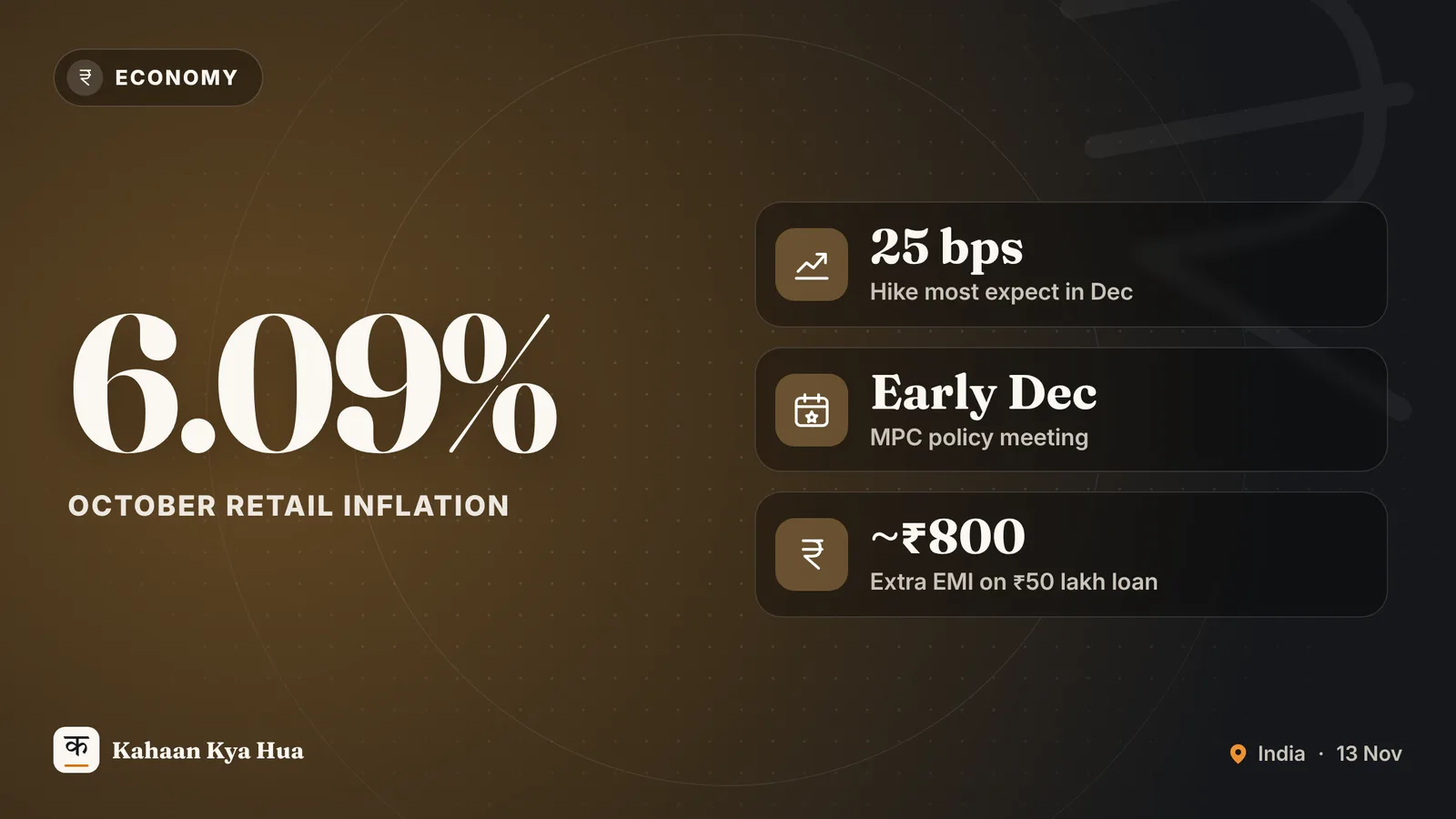
After retail inflation crossed the Reserve Bank of India's 6% ceiling in October, most economists now expect the central bank to raise the repo rate again at its early-December policy meeting. A higher repo rate usually means dearer loans for borrowers and slightly better returns for depositors, so the decision matters to households as well as markets.
Where inflation stands
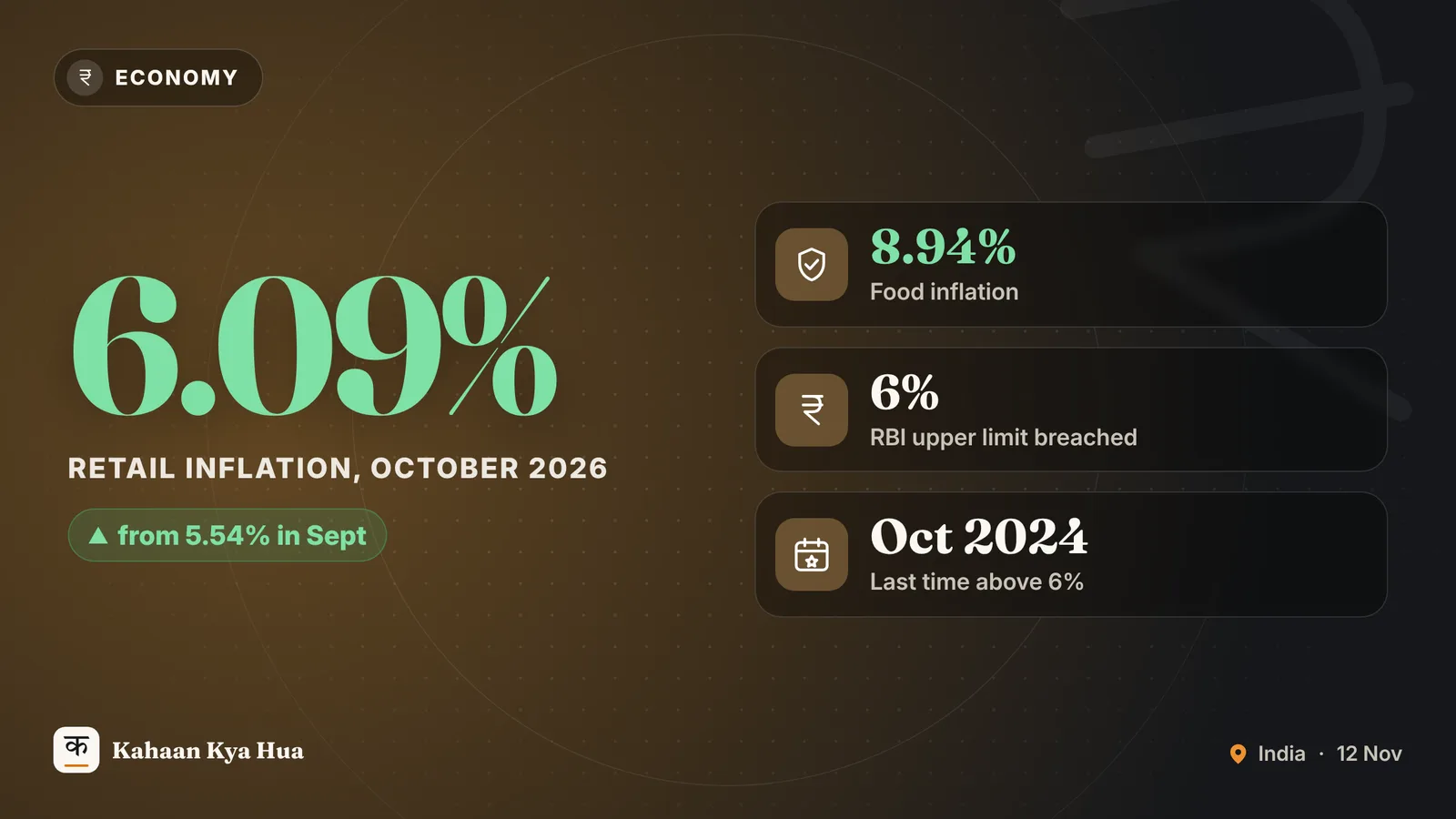
The National Statistics Office reported that retail inflation rose to 6.09% in October, a two-year high, from 5.54% in September, according to Hindustan Times, The Times of India and Deccan Herald. That is above the RBI's upper tolerance limit of 6% and well above its 4% medium-term target, which inflation has exceeded for several months in a row.
Food is the main driver, but price pressure is spreading. Hindustan Times reports that inflation rose in 11 of the 12 major categories in the consumer price basket, and Deccan Herald reports restaurant and accommodation inflation at above 10%. The two outlets give slightly different food inflation figures for October (8.51% for the food and beverages group in one, 8.94% for food in the other), so readers should treat the exact food number with care. Core inflation, which leaves out food and fuel, was about 4.6% to 4.75% depending on the measure used.
What economists expect
Economists quoted by The Times of India expect the Monetary Policy Committee (MPC) to raise rates after its meeting in early December. This would follow the first rate hike in over three years, which the RBI made in October.
- SBI says the odds have moved firmly towards a 25 basis point hike in December rather than the 50 it had projected earlier. It cites a more stable rupee, returning capital flows, a softer oil price outlook and easing US bond yields. SBI also says the earlier expectation of three or four hikes in a row now looks like an outlier.
- Crisil, CareEdge and ICRA all expect a 25 basis point hike. ICRA's Aditi Nayar called it almost certain, and said the path after that depends on crude oil prices.
- Barclays expects 25 basis points in December and a final 25 in February 2027, taking the repo rate to 6.00%. Going by that arithmetic, the rate is now 5.50%, though this is our reading and not a figure stated in the reports.
- Kotak Mahindra Bank, Elara Capital and HDFC Bank see a cumulative 50 basis points over the current financial year, with Kotak flagging more upside risk if food prices flare up.
One basis point is one-hundredth of a percentage point, so 25 basis points is a quarter of a percentage point.
What it could mean for your EMI
Home and other loans linked to the repo rate usually reset after a policy hike, though the timing depends on your lender and loan type. As a simple illustration, our own calculation shows that on a floating-rate home loan of ₹50 lakh over 20 years, a rise from 8.5% to 8.75% would lift the monthly instalment from about ₹43,400 to about ₹44,200, roughly ₹800 more a month. Your numbers will differ with the loan size, remaining tenure and whether your lender raises the rate or stretches the tenure instead.
Savers may see small gains. Banks tend to raise fixed deposit rates after a policy hike, but usually by less and with a lag.
Why the RBI may not go further
The RBI's October policy projected headline inflation at 5.2% for 2026-27, with 6% in the October-December quarter and 5.7% in January-March. Crisil expects an average of 5.3% for the year, with risks on the upside. CareEdge expects inflation to peak in the current quarter. The argument for a short hiking cycle is that price rises should ease a little from here while staying elevated.
The risks run both ways. A weak monsoon has clouded the kharif crop and rabi sowing has lagged, which Crisil says could keep food prices high through the rest of the year. Deccan Herald also reports that Amul and Mother Dairy raised milk prices in Delhi NCR from Thursday. If oil prices rise again, the RBI may have to do more.
What to watch next
The next signals are the November inflation print in mid-December, the MPC's meeting in early December and the rupee and crude oil prices. If you hold a floating-rate loan, check with your lender how and when a rate change would reach your EMI, and avoid taking a larger loan only on the assumption that rates will fall soon.