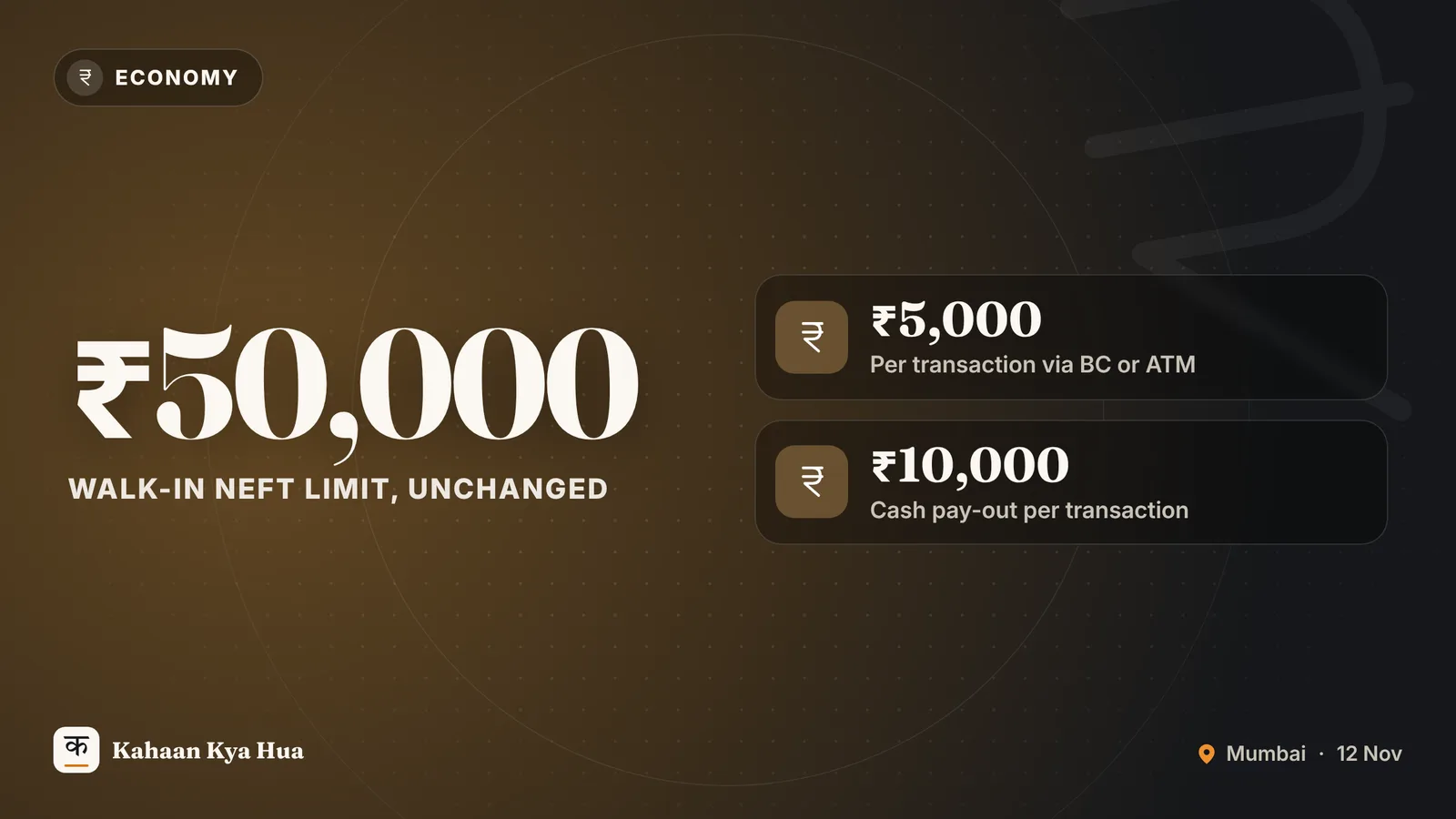
The Reserve Bank of India (RBI) on Wednesday, 11 November 2026, issued the Reserve Bank of India (Domestic Money Transfer) Directions, 2026. The Directions bring together earlier instructions on sending small amounts of money within India for people who may not have a bank account. They came into effect the same day. The headline limit, ₹50,000 through NEFT for a walk-in customer, is not new. The Economic Times describes the exercise as consolidation without a change in the ceiling.
What are the new rules for walk-in customers?
A walk-in customer is someone who goes to a bank branch without an account there. According to the Directions, as quoted by Hindustan Times and Millennium Post, such a customer can use the cash pay-in service to remit up to ₹50,000 to a beneficiary's bank account through NEFT.
Banks are also allowed to let these customers send money to a beneficiary's bank account through Business Correspondents (BCs), the agents who work for banks in smaller places, and through ATMs. This channel is capped at ₹5,000 per transaction, with a monthly limit of ₹25,000 per remitter.
What about people who receive cash?
The Directions also cover the other direction. Banks can offer a service where money is moved from a customer's bank account and delivered in cash to a recipient who has no bank account, either at an ATM, through a BC or through another authorised payment channel. This is called the Cash Pay-out Service.
The maximum under this service is ₹10,000 per transaction, with an overall monthly ceiling of ₹25,000 per beneficiary. Card-to-card transfers are outside the scope of these Directions.
Why does the RBI have this framework?
The Domestic Money Transfer framework was created to help small-value transfers go through formal banking channels. Hindustan Times says it is aimed particularly at people, including migrant workers, who have no easy access to such channels because they lack proof of identity or address. A construction worker in a city who wants to send money home to a family member with a bank account in a village is the kind of user the framework has in mind.
What safeguards are required?
Banks and non-bank entities offering these services must put in place strong safeguards, the RBI said. These include velocity checks, which flag too many transactions in a short time, and alerts to customers about credits into their accounts. The Directions state that any unusual spurt in the volume of credits in a particular account or group of accounts should be investigated immediately, and that the appropriate authorities should be alerted about suspicious transactions.
Transfers under the facility are expected to be completed in real time or near real time.
What changes for you?
Based on the reports, the limits themselves are the same as before: ₹50,000 for NEFT through a branch, ₹5,000 per transaction and ₹25,000 a month through BCs and ATMs, and ₹10,000 per transaction and ₹25,000 a month per beneficiary for cash pay-out. The difference is that these instructions now sit together in one set of Directions, which makes it simpler for banks and customers to see what is allowed.
If you plan to use this service, ask your bank or the BC about the exact documents and charges, because the reports we read do not specify them. The Directions as reported do not say whether any identity document is required, and we have not seen the full text.
What next
Banks and non-bank operators will now have to follow the consolidated Directions. Any customer who is unsure about a transfer should use the branch or the bank's official helpline rather than a stranger offering to send money on their behalf.