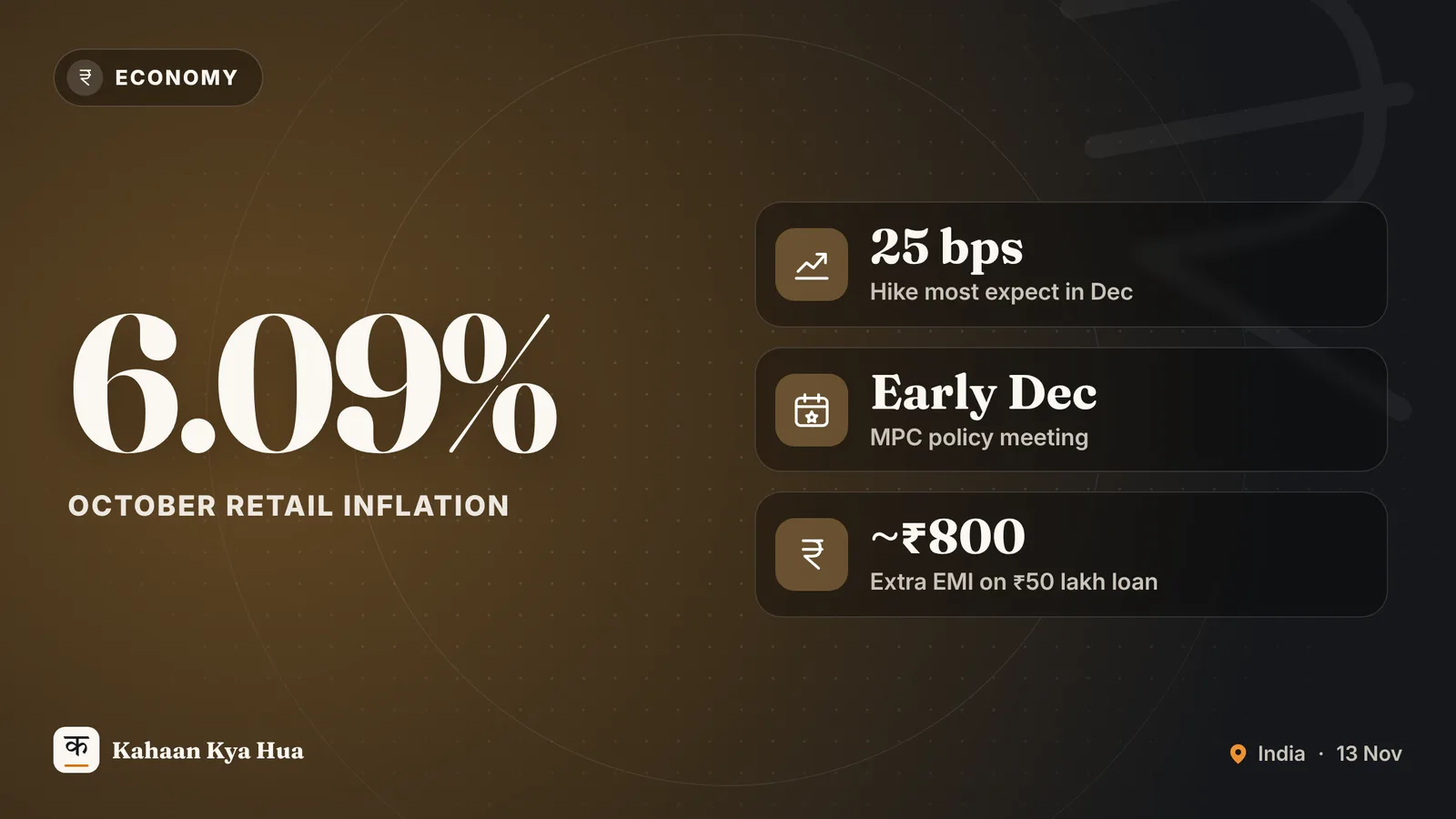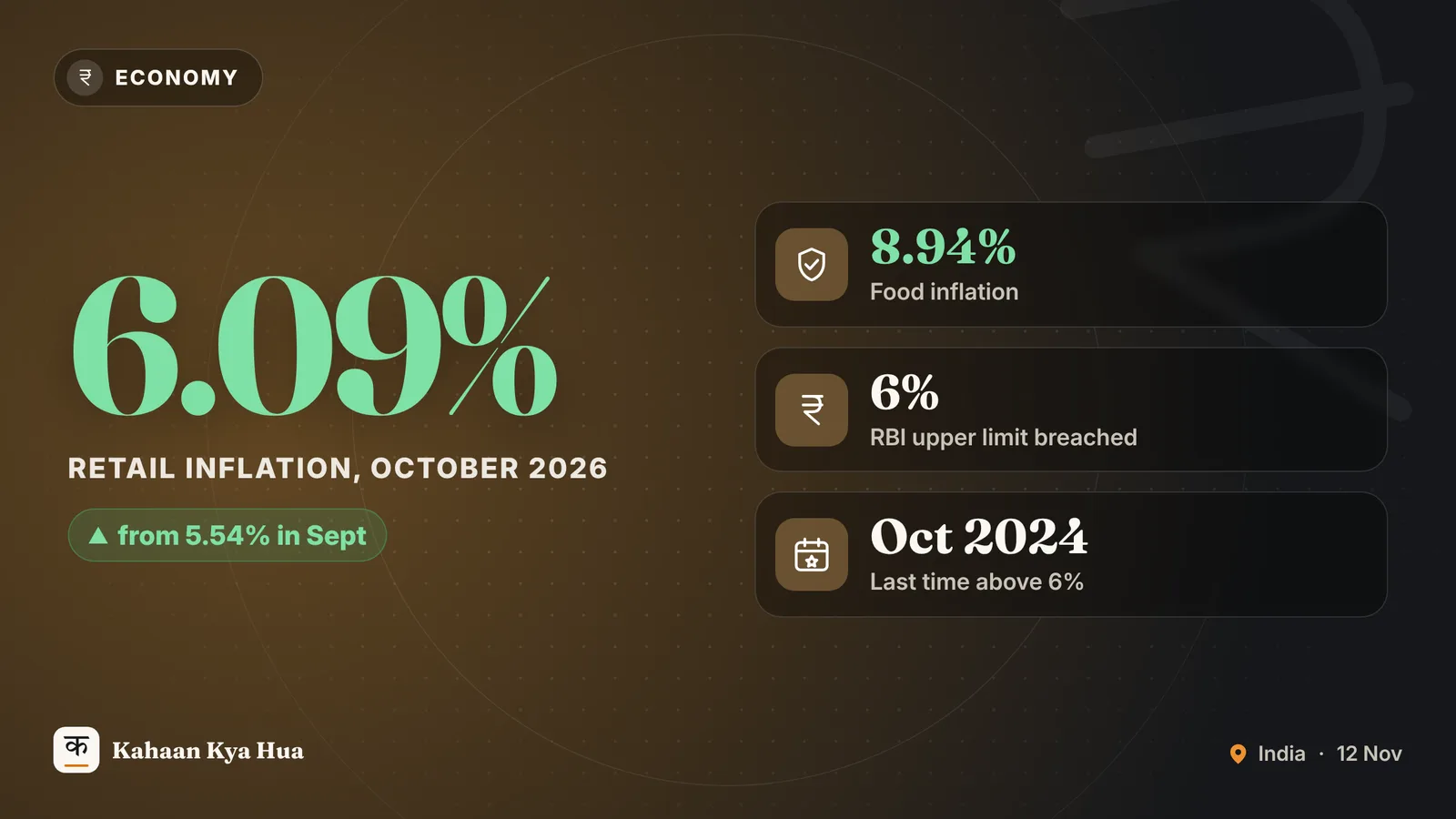
Prices rose faster in October than at any point in the last two years. Retail inflation, measured by the Consumer Price Index (CPI), came in at 6.09 per cent in October 2026, according to government data released on Thursday. That is higher than the 5.54 per cent recorded in September and above the 6 per cent upper limit that the Reserve Bank of India (RBI) is expected to stay within.
What the numbers say
The RBI works to a 4 per cent inflation target with a comfort band of 2 percentage points on either side. October's reading is the first time in two years that inflation has gone past the top of that band. The last time it did so was in October 2024, when it was about 6.2 per cent, according to The Hindu and PTI.
The main push came from food. Food inflation rose to 8.94 per cent in October from 7.74 per cent a month earlier, according to Ministry of Statistics and Programme Implementation data reported by PTI. The Hindu, using the broader food and beverages division of the new CPI series, puts that category at 8.5 per cent, the highest since the series began. The two figures measure slightly different baskets, which is why they differ.
Which items got costlier
The five items with the sharpest yearly price rise, according to the PTI report, were:
- Onion: 116.22 per cent
- Garlic: 60.74 per cent
- Silver jewellery: 52.39 per cent
- Ginger: 48.32 per cent
- Lemon: 47.30 per cent
It was not only the kitchen. The Hindu reports that transport inflation rose to 5.8 per cent, a series high, as fuel prices climbed. Restaurants and accommodation services saw inflation of 10.1 per cent, the first double-digit reading in the new series. Clothing, communication and recreation categories also moved up. Inflation was higher in rural areas than in cities, according to an RBI bulletin cited by the newspaper.
A new CPI series
This is the first full set of numbers from the new CPI series with 2024 as the base year, so detailed category data goes back only to January 2026. That means long-term comparisons by category are limited. The headline figure, however, can still be compared with earlier years.
What it means for the RBI and for borrowers
In October, the RBI raised the repo rate by 0.25 percentage points to 5.50 per cent, its first increase in several years, and signalled that further hikes could follow amid rising inflation, a weak rupee and high crude oil prices. The rupee closed at about 94 to the US dollar on Thursday, and Brent crude was around 92 dollars a barrel.
Pranjal Ghate, an economist at Brickwork Ratings, told The Hindu that the latest reading makes it increasingly difficult for the Monetary Policy Committee to hold rates unchanged at its December meeting, and strengthens the case for another 25 basis point hike. A higher repo rate generally leads banks to raise interest on new loans, which can make home and car loans costlier.
Madan Sabnavis, chief economist at Bank of Baroda, cautioned that some food prices could rise further. He pointed to lower sowing area for rice, maize, oilseeds, cotton and sugarcane, and reports of weaker pulse production, especially tur. Harvest prospects will show how food prices behave in the coming months, he said.
The Hindu also noted that festive-season demand may have added to price pressures, on top of supply-side problems.
What to watch next
- The next RBI Monetary Policy Committee meeting in December, where a rate decision is due.
- November inflation data, due in mid-December.
- Vegetable prices as winter arrivals build up, and the progress of the harvest.
For households, the immediate impact is on the monthly grocery and eating-out bill. Onion, garlic and ginger are staples in most Indian kitchens, so their steep rise is felt quickly. Economists say that unless harvest arrivals improve, the pressure on food prices may continue for a few more months.