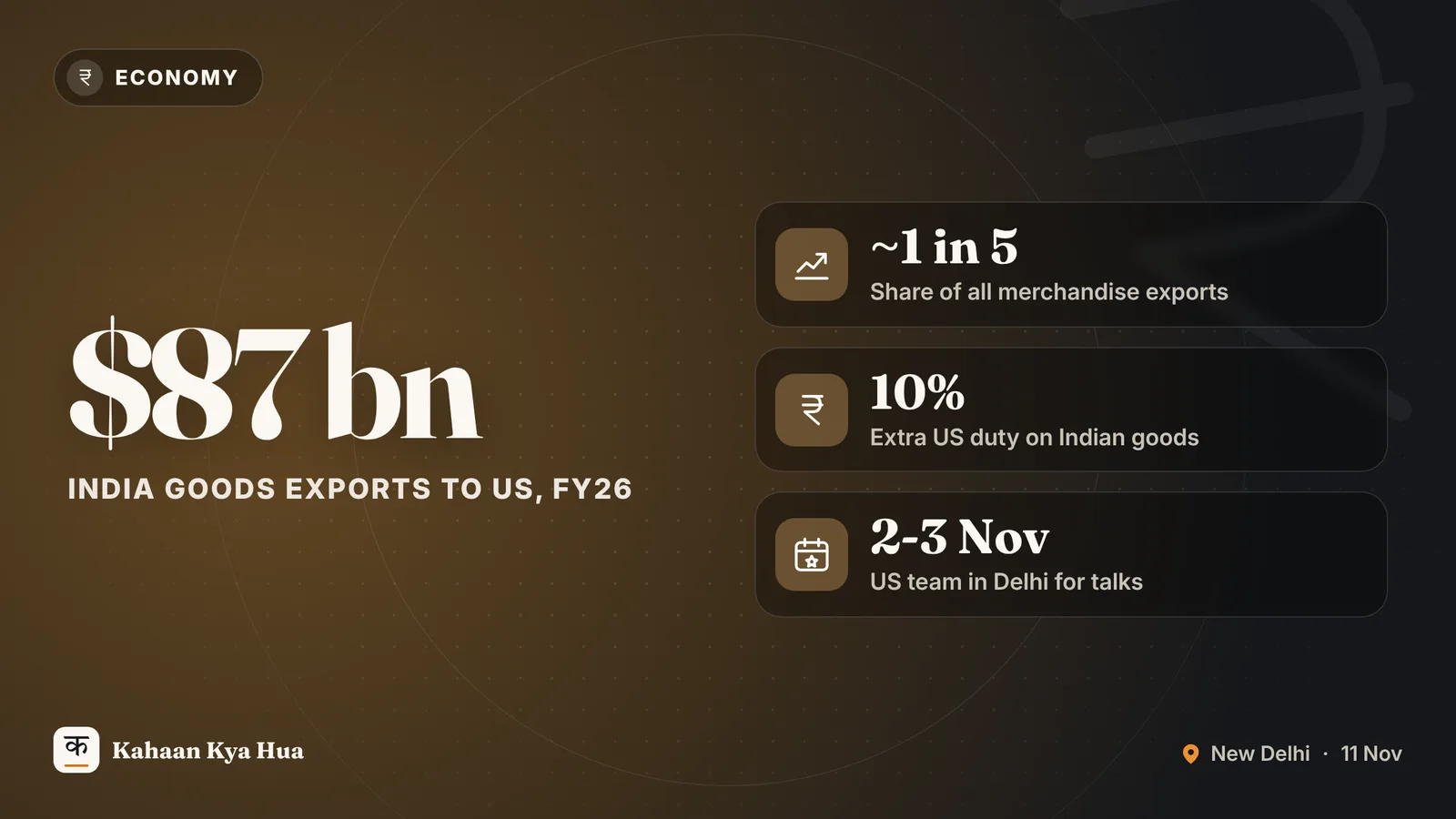
India and the United States are still negotiating the first part of their proposed trade agreement, and Delhi says the political setback for President Donald Trump's party in the American midterm elections will not derail the talks. A senior government official said on Tuesday that a two-member US team was in New Delhi on 2 and 3 November for technical discussions, according to reports by The Economic Times and Mint, and that the two sides remain in regular touch.
What was discussed in Delhi
The US team's visit focused on the customs and trade facilitation chapter of the agreement, the part that deals with how goods are cleared, documented and moved across borders. Officials described it as a technical track that carries on while the larger political questions are sorted out. Hindustan Times also reported that both sides are pushing for an early bilateral deal.
The talks are about a "first tranche", meaning a first phase of the wider Bilateral Trade Agreement rather than the full pact. Earlier this year, the two countries announced a framework for that first phase. Under it, Washington dropped a 25% penalty on India linked to purchases of Russian energy, and the baseline reciprocal tariff on Indian goods was lowered to 18%, as per The Economic Times.
Why the US midterms raised doubts
In the US midterm elections, President Trump's Republican Party lost its majority in both the Senate and the House of Representatives, as reported by The Economic Times. That has raised questions about how easily his administration can push a trade agenda through Congress, even though the president keeps his executive powers.
Mint reported that a spokesperson of the American embassy in New Delhi said on 4 November that the president remains firmly in command of US foreign policy, and that the election results do not change Washington's commitment to the partnership with India. Experts quoted by Mint see both sides of the coin: a Congress controlled by the opposition could make it harder to ratify a deal, while Trump's weaker position could give India more leverage at the table.
The tariff picture is already messy
The framework has been overtaken by court and legal events. On 20 February, the US Supreme Court struck down Trump's reciprocal tariffs imposed under the International Emergency Economic Powers Act. Washington has since added a 10% duty on Indian goods under a Section 301 investigation into alleged forced labour. The same duty applies to 16 other countries, and it is lower than the 12.5% the US had proposed in June. A separate Section 301 probe into alleged excess capacity in India is also under way.
According to Mint, about 55% of Indian shipments to the US, including engineering goods, textiles and garments, and gems and jewellery, face the usual most-favoured-nation duties plus this 10% charge. Another 35 to 40% of goods, such as smartphones, medicines and some farm products, are exempt. Steel and aluminium face much higher duties. In textiles and garments, US duties can go up to 32%, while most gems and jewellery attract 5.5 to 6%.
Why it matters for Indian workers and exporters
The US is India's biggest export market. India sold goods worth $87 billion there in 2025-26, nearly a fifth of its total merchandise exports. Mint says the sectors most likely to gain once a deal takes effect are labour-intensive ones: textiles, garments, leather goods, and gems and jewellery. Many such units employ large numbers of workers, including in Uttar Pradesh clusters such as leather in Kanpur and garments in Noida, so tariff certainty directly touches jobs and order books.
For exporters, a signed deal would mean more predictable tariffs and the ability to price contracts with more confidence. Delhi is seeking lower US tariffs than those paid by rivals such as Bangladesh, Vietnam and Cambodia, according to The Economic Times.
What India may offer in return
Experts quoted by Mint expect India could cut tariffs on a select list of American farm products and buy more US crude oil and liquefied natural gas. The agreement also aims to deepen cooperation in defence technology and critical minerals. None of this has been officially confirmed as final, and neither government has announced a date for signing.
What next
Technical meetings are expected to continue. Mint said its questions to the US trade office, the US commerce secretary, the American embassy and India's commerce ministry were not answered immediately. Readers should treat reported terms as unconfirmed until the two governments publish the text of the first tranche.