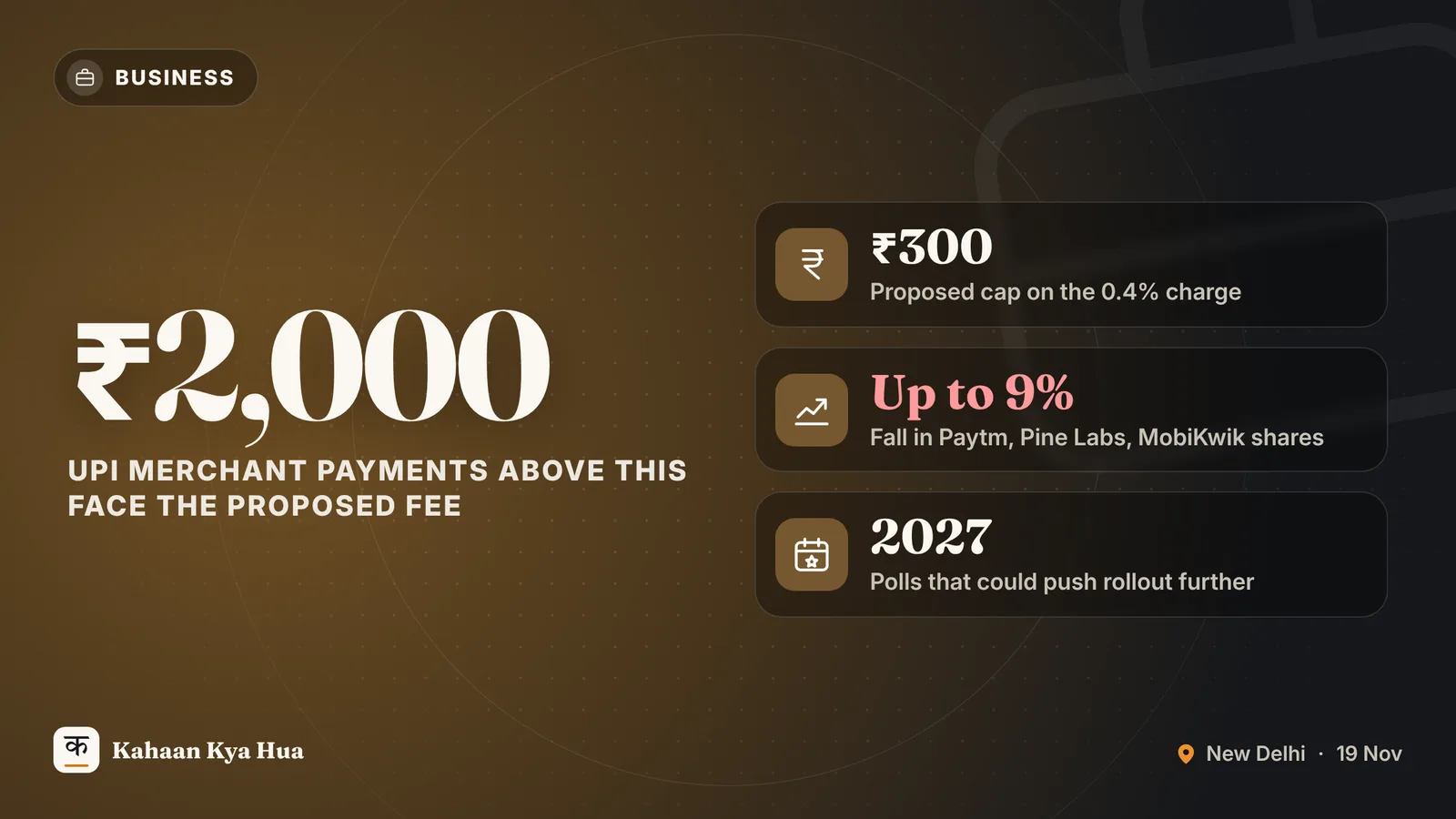
A reported delay to the planned fee on large UPI merchant payments knocked listed fintech stocks lower on Thursday, even though nothing has been officially announced. Shares of Pine Labs, Paytm and One MobiKwik Systems fell as much as 9% during the day, according to Mint, as investors weighed what a further postponement would mean for their revenue.
What has been reported
Mint, citing a Reuters report that quotes people familiar with the matter, says the government is considering delaying the rollout of a fee on large UPI payments by a few months. A final decision by the National Payments Corporation of India (NPCI) is yet to be taken but is expected in the coming days. Business Today, summarising a Financial Express report, says implementation could even be pushed beyond the 2027 assembly elections in Uttar Pradesh, Punjab, Uttarakhand, Goa and Manipur. The same report stresses that industry officials describe a further postponement as a possibility rather than a confirmed government decision. Discussions between the government, the Reserve Bank of India and NPCI are said to be continuing.
Because these accounts rely on unnamed sources, they should be read as unconfirmed until NPCI or the government says something on record.
What the proposed charge is
Per Mint, the framework would apply a merchant discount rate (MDR) on person-to-merchant (P2M) UPI payments above ₹2,000. The charge is borne by the merchant and not the customer, and is capped at ₹300 for transactions of ₹75,000 or more. Payments between individuals, and most everyday merchant transactions, stay free.
Business Today adds more detail from NPCI's framework. Select merchant categories, including railways, telecom, insurance and fuel, would attract a flat ₹5 on transactions above ₹2,000, while large-merchant transactions above ₹2,000 would attract 0.4%, capped at ₹300. The charges are expected to cover about 4% of merchant transactions, with more than 95% of P2M payments outside their scope, and small merchants under the person-to-person merchant model would continue at zero MDR.
Why the date keeps moving
The fee was originally to start on 15 October, a date that would have fallen in the October to December festive season when spending peaks. Business Today says it was then postponed until after Diwali, and NPCI is yet to announce a revised date. Mint's sources say a delay would give payment firms more time to upgrade systems and avoid passing extra costs to customers, and would ease operational problems for retailers during the busy season.
Opposition is also coming from the trade. The All India Consumer Products Distributors Federation (AICPDF), in an 11 November letter to the Finance Minister reported by NDTV Profit, asked the government to suspend implementation and exempt merchant-to-merchant (M2M) payments, clarify GST implications and consult stakeholders first. It warned that thin-margin distributors handling large volumes would be hit, and said promised consultations had not taken place.
What it means for the stocks
Fintech companies have been counting on the MDR as a way to earn money from UPI, which has been free for merchants for over six years. Mint says brokerages see a large pool at stake: Jefferies estimates a revenue opportunity of about ₹5,000 to ₹10,000 crore for large payment platforms such as Paytm and Pine Labs, with third-party app providers capturing roughly 8 to 12 basis points of a 40-basis-point fee. Bernstein has estimated a pool of up to about ₹22,000 crore by FY28 for the whole payments ecosystem, and Citi has put the annual opportunity at around ₹16,000 to ₹17,000 crore. A delay pushes that income further out, which explains the sell-off. Mint notes that the long-term opportunity remains significant, and that the Bernstein figure is for the sector as a whole, not for any single company.
What UPI users should know
For an ordinary customer paying a shopkeeper, a chai seller or a friend, nothing changes today. The proposed charge is on the merchant side and only for larger payments. NPCI's 11 November circular also launched the UPI Vyapaar Saksham scheme, a three-year programme funded by MDR collections to support QR-code and soundbox deployment among smaller merchants once the charges start. That scheme depends on the fee, so a delay would also push back the support for small shops.
What to watch next
The next marker is an NPCI announcement. If it confirms a new date, it will also show whether the rates and the ₹5 flat charge for select categories stay as proposed. Until then, treat claims of a fixed date, in either direction, with caution. We will update this report once NPCI or the Finance Ministry confirms any change.