Retirees who have so far taken their provident fund as one large cheque may soon be able to draw it like a pension. The Central Board of Trustees (CBT) of the Employees' Provident Fund Organisation (EPFO) on Thursday approved a Systematic Withdrawal Plan, along with changes that make it easier to reach your own PF money while you are out of work.
What the board decided
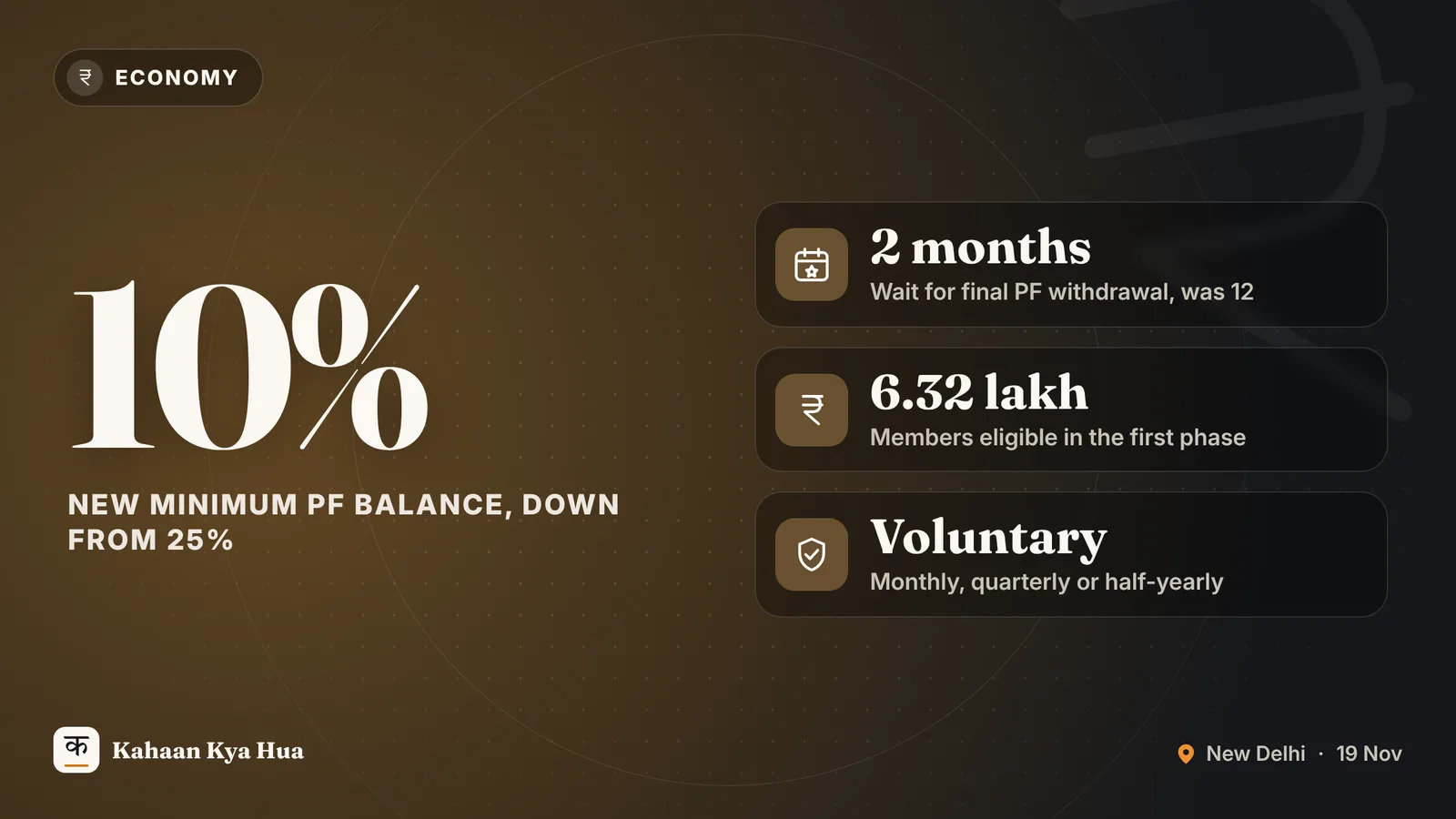
The decision came at the 240th CBT meeting in New Delhi on 19 November 2026, chaired by Union Labour and Employment Minister Mansukh Mandaviya, according to CNBC-TV18. Under the Systematic Withdrawal Plan (SWP), a retiring member can receive the accumulated PF savings in periodic instalments instead of taking the whole amount at once. The Times of India reports that the options will be monthly, quarterly or half-yearly payments, and that taking part is entirely voluntary. Anyone who prefers a lump sum can still take one.
The unwithdrawn balance stays invested and keeps earning returns, which is meant to give retirees a steadier income and reduce the risk of having to reinvest a large sum at a bad moment. The Hindu quotes EPFO sources as saying the member keeps ownership of the underlying corpus throughout.
What happens if the member dies
If a member dies during the payout period, the nominee or dependent can either withdraw whatever balance remains or carry on receiving the periodic payments. EPFO sources told ANI that this is meant to protect families as well as the retiree.
Two rule changes that affect everyone
The board also approved two changes that apply beyond retirees. The minimum balance a member must keep in the account is being lowered from 25% of contributions to 10%. And the waiting period for a final PF withdrawal after losing a job is being cut from 12 months to two months. Both outlets say the aim is to give members more access to their money while still protecting long-term social security.
For a worker who loses a job, the shorter wait can matter a great deal. Until now a full settlement could be claimed only a year after unemployment. The new two-month window, once it is notified, shortens that gap substantially.
Who benefits first
In the initial phase, about 6.32 lakh EPF members aged above 55, each with PF savings of more than ₹5 lakh, are expected to be the main beneficiaries, according to the Times of India and CNBC-TV18. The proposal also envisages UAN-linked facilities through which members can make voluntary deposits, and third parties can make small contributions such as customer tips, without going through an employer's payroll. This is seen as a way to widen coverage to gig and platform workers.
Other approvals at the meeting
The board gave in-principle approval for EPFO to invest up to 3% of fresh accretion in eligible alternative investment funds, within the existing overall investment ceiling, initially through government-backed entities. It cleared amendments to the EDLI Scheme, 2026, giving eligible establishments six months to renew expired exemptions and relief on contributions, interest and penal damages for a verified transition period. It also reviewed the surrender or cancellation of exemptions by 31 establishments, a move that brings about ₹5,996 crore of savings belonging to 1,44,437 members under EPFO's direct administration.
What is still pending
None of this changes your PF account today. The required amendments to the EPF Scheme will be notified after the Labour Ministry approves them, and a corresponding amendment to the Income Tax Act is being taken up with the Finance Ministry. Tax treatment of the instalments is therefore not yet clear. Until the notification is out, EPFO has not announced a start date, an application process or a minimum corpus for opting in.
What members should do now
There is nothing to apply for yet. Members close to retirement can use the time to check that their nominee details and UAN-linked bank account and KYC are up to date, since those will matter whichever withdrawal route they pick. Once the notification arrives, the key questions will be how the instalment amount is set, whether it can be changed midway, and how the interest on the remaining balance is credited. We will update this report when EPFO issues the formal notification.