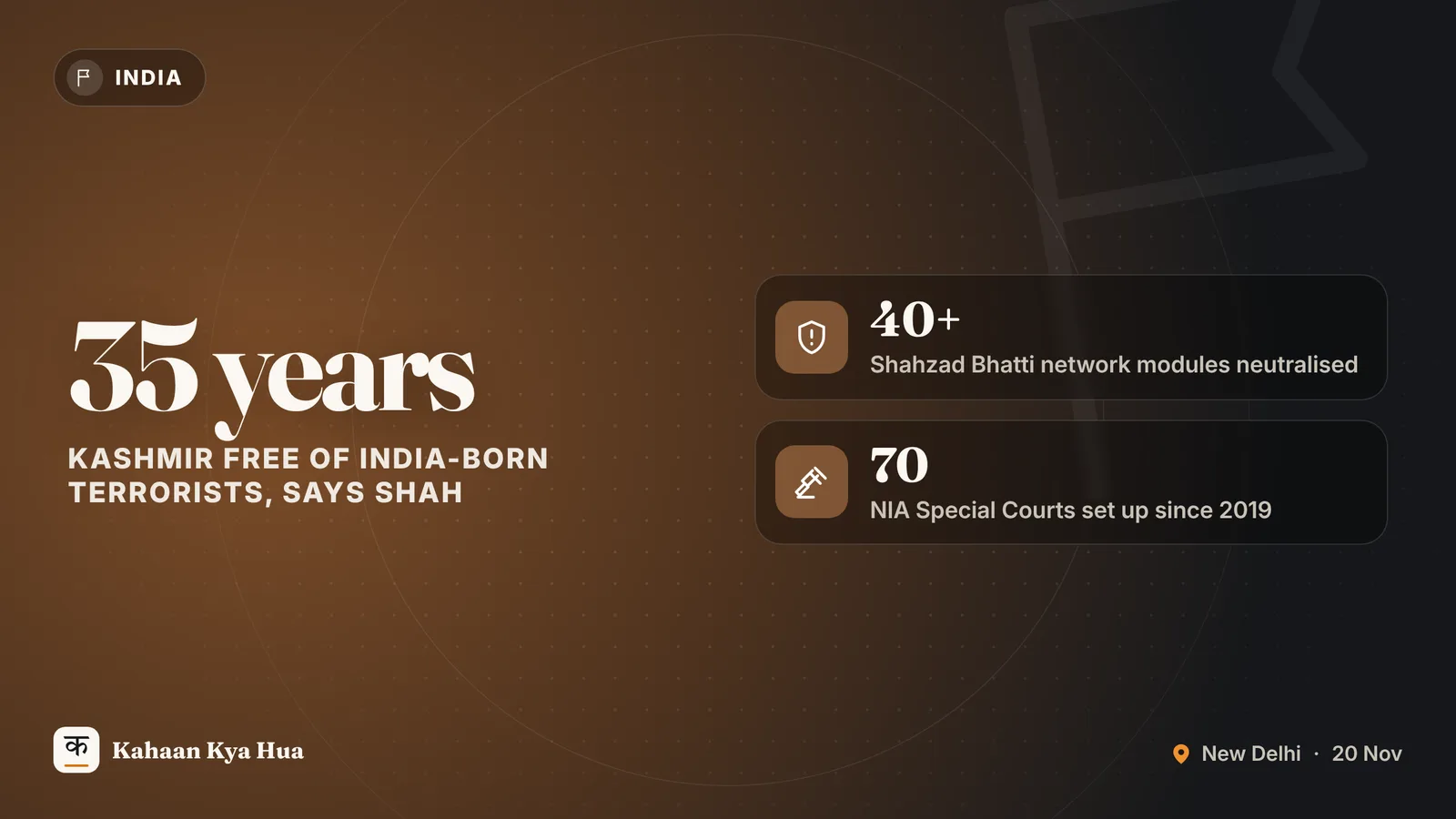
Union Home Minister Amit Shah said on Thursday, 19 November 2026, that Kashmir is now free of India-born terrorists for the first time in 35 years, a day after security forces killed Lashkar-e-Taiba militant Lateef Bhat in Kulgam. He was speaking at the opening session of a two-day counter-terrorism conference organised by the National Investigation Agency (NIA) in New Delhi. The Hindu and Hindustan Times both reported his speech, which also covered a revamped intelligence-sharing platform, cyber capacity in state police units and the money trail behind terror networks.
What did Mr Shah claim about Kashmir?
According to Hindustan Times, Mr Shah called the killing of Lateef Bhat a significant milestone and said it had left the whole of Kashmir without any India-born terrorist for the first time in 35 years. He credited the government's sustained efforts and its zero-tolerance approach to terrorism. The Hindu carried the same claim. This is the Home Minister's own assessment, and the reports did not carry any independent verification or a count from security agencies.
The Multi-Agency Centre gets a wider brief
The Hindu reported that the Multi-Agency Centre (MAC), a centralised intelligence-sharing platform that works under the Intelligence Bureau, now tracks cybersecurity, narcotics, organised crime networks and emerging radicalisation hotspots. The MAC was conceived in 2001, after the Kargil war, and became fully operational in 2009. In 2025 its network was revamped to link every police district in the country through a secure network. Mr Shah said the working of the MAC had been reorganised.
He asked the Anti-Terrorism Squads (ATS) of every state to strengthen their cyber-expert units, since technology is increasingly used in such crimes.
One system down to the police station
Mr Shah said that in a country as large as India, a system is being put in place, from Kashmir to Kanyakumari and from Dwarka to Kamakhya, under which a uniform strategy against terrorism works down to the level of every police station. He acknowledged that state police forces had made various efforts in the past but that the lack of coordinated action was clearly visible. He asked for a mechanism through which police-station-level intelligence reaches the Director General of Police at the state level, so that actionable intelligence can be drawn out. He also called a Quadrangular Regional Security Grid in border states a key priority.
The Shahzad Bhatti network
Hindustan Times reported that Mr Shah cited joint action by police in several states and central agencies against the Shahzad Bhatti Network, which has been declared a terrorist organisation under the Unlawful Activities (Prevention) Act (UAPA). According to the Home Minister, more than 40 of its modules have been neutralised, over 100 cases registered and more than 271 arrests made. He asked police in every state to study this model and adopt it. He also pointed to the dismantling of the Popular Front of India network in September 2022, in which police from 11 states and central agencies took part, as an example of coordinated action. He added that the whole chain of terror financing must be targeted, with better coordination with financial investigation agencies.
What else was announced at the conference?
The Hindu reported that Mr Shah released an NIA publication titled Fail-Safe Investigation, laid the foundation stone of the agency's office complex in Chandigarh, inaugurated its residential complex at Maidangarhi in Delhi and e-launched the NIA's Pushti portal. Home Secretary Govind Mohan and NIA Director General Rakesh Aggarwal were present.
He recalled that a unified action plan against radicalisation was prepared in September 2019 and finalised in December that year after consultations with ministries. A National Memory Bank was set up and work began on a centralised database. Over the years, he said, the NIA's legal powers have been enhanced and 70 new NIA Special Courts have been established across the country, while UAPA provisions have been strengthened. Hindustan Times added that, according to him, 303 fugitives have been brought back to India from 36 countries since 2019 under a special drive.
A note on the claims
The claims about the Kashmir situation and the Shahzad Bhatti network come from the Home Minister's speech, and the figures cited have not been separately confirmed by the agencies involved in the reports we reviewed.
What next?
The conference runs for two days and brings together senior police officers from states and Union Territories, counter-terrorism agencies and experts from fields such as law, forensics and technology. Any specific policy steps, such as guidelines on cyber units or the border security grid, would be announced by the Ministry of Home Affairs. We will update this report if further details are published.