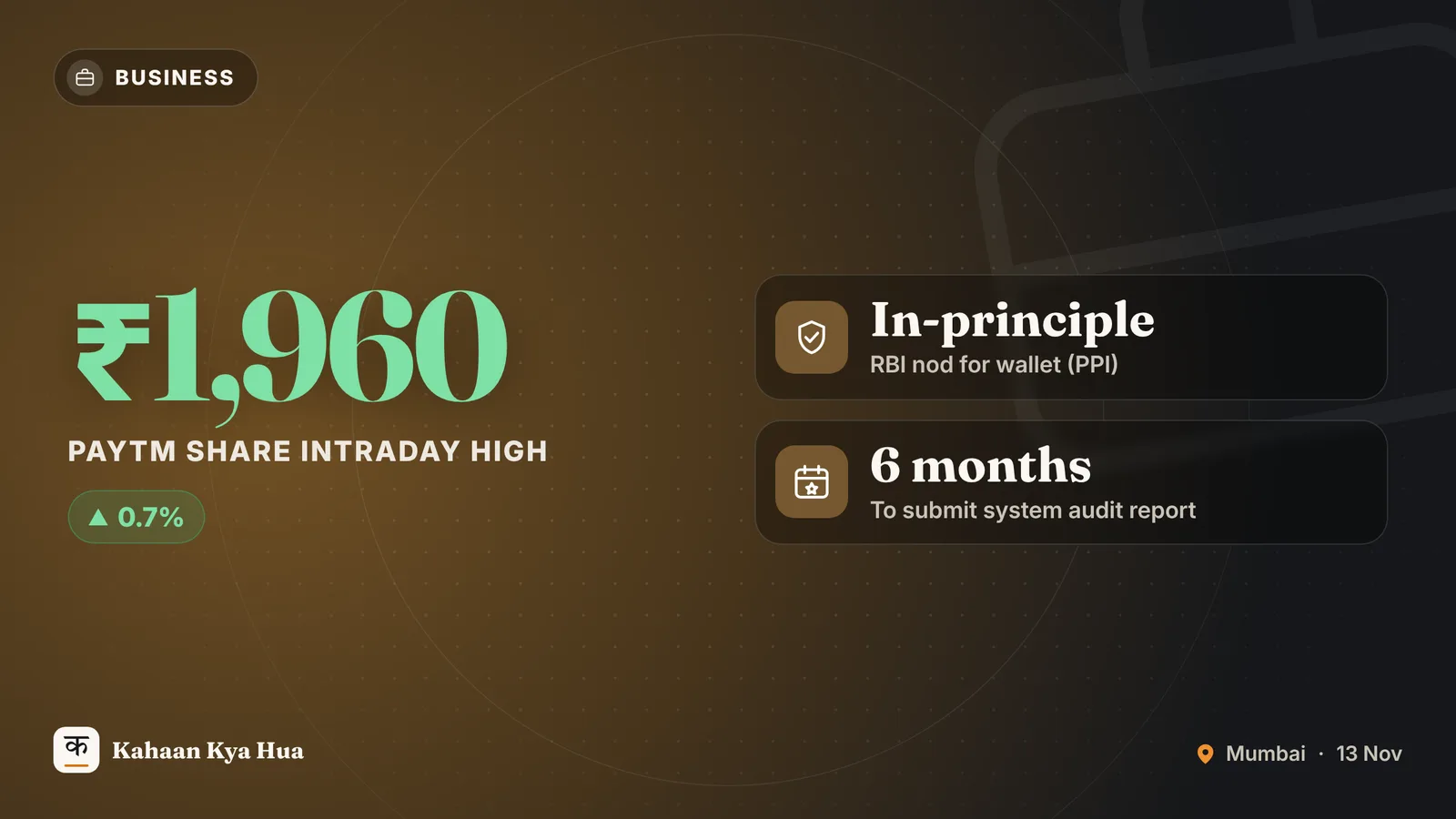
Paytm has moved a step closer to bringing back its digital wallet. On Friday, 13 November 2026, One97 Communications, the parent of Paytm, said the Reserve Bank of India (RBI) had given its subsidiary Paytm Payments Services Ltd (PPSL) in-principle approval to issue prepaid payment instruments (PPIs). The news pushed the stock above the level it touched on its first day of trading in November 2021.
What the RBI has actually approved
PPIs are products such as digital wallets, where users store money in advance and then use it to pay merchants, transfer funds or make remittances. According to the company's stock exchange filing, as reported by Mint, PPSL received an RBI letter granting in-principle authorisation under the Payment and Settlement Systems Act, 2007.
This is different from an earlier permission. In August 2025, PPSL was authorised as an online payment aggregator, which lets it process payments for merchants. A PPI licence covers issuing wallets, a separate activity.
Why this is not yet a wallet relaunch
The approval is preliminary. PPSL can start issuing wallets only after it gets final authorisation, called a Certificate of Authorisation, from the RBI. To get there it has been told to carry out a system audit, including a cybersecurity audit, and to submit the report within six months. Mint reports that the audit must be done by an auditor empanelled with CERT-In, a Certified Information Systems Auditor registered with ISACA, or a holder of the DISA qualification from the Institute of Chartered Accountants of India. If the report is not submitted in time, the in-principle approval will lapse and the RBI will not consider a final authorisation after that.
The two reports date the deadline slightly differently. Mint says six months from 13 November 2026, while The Hindu puts it at June 2027. Either way, ordinary users should not expect to load money into a Paytm Wallet immediately.
The company itself has said the financial impact will become clear only after final authorisation is received.
How Paytm got here
Paytm's wallet business had effectively come to a standstill after the RBI placed strict restrictions on Paytm Payments Bank in 2024, barring fresh deposits, credits and wallet top-ups in existing customer accounts, citing repeated compliance failures and supervisory concerns. Mint reports that the RBI cancelled the bank's licence on 24 April 2026. The new approval gives Paytm a separate route to rebuild the wallet, rather than depending on the former bank.
What the share price did
According to Mint, Paytm shares rose nearly 2% during trading to ₹1,960, crossing the listing-day high of ₹1,955 for the first time since the November 2021 debut. The Hindu reports that the stock ended 0.7% higher at ₹1,939.90 on the NSE after rising as much as 1.8% in the session. So the stock touched a record intraday level but closed a little below it. Readers should treat these as market moves, not advice to buy or sell.
The business backdrop
The approval comes as the company's results have improved. For the quarter ended September, Paytm reported a nearly ten-fold year-on-year rise in consolidated net profit to ₹225 crore. Revenue rose 28% to ₹2,648 crore, and EBITDA, or earnings before interest, tax, depreciation and amortisation, increased 90% to ₹270 crore, according to The Hindu.
What to watch next
Three things matter from here. First, whether PPSL completes the system and cybersecurity audit well inside the six-month window. Second, whether the RBI grants final authorisation, which is the step that actually allows the wallet to go live. Third, how quickly Paytm can win back users who moved to other apps and UPI-linked options while its wallet was frozen.
For the millions of people who still use Paytm for UPI payments, nothing changes today. The wallet, and any balance or top-up features, will come back only if and when the RBI gives its final nod.