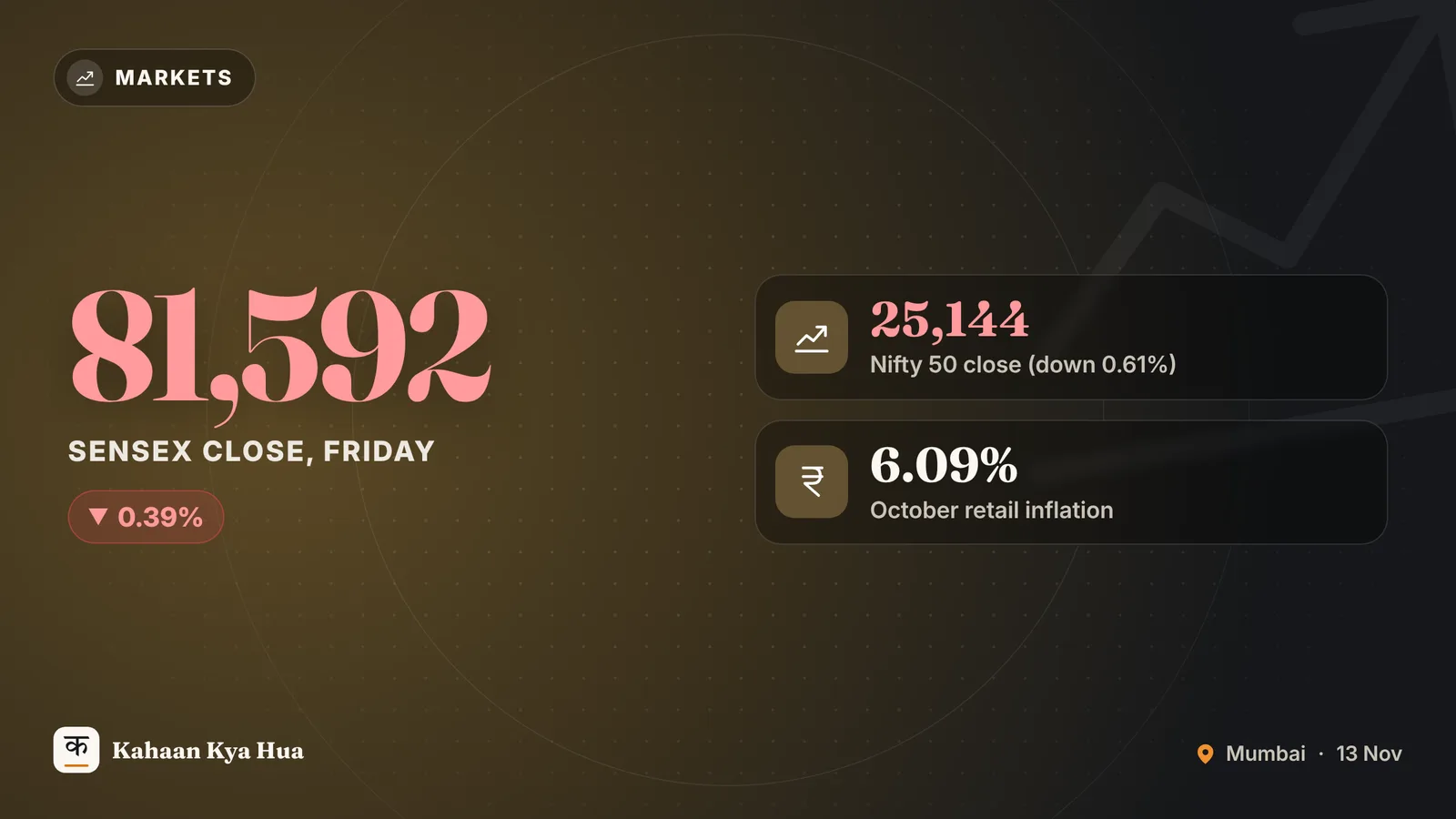
Indian shares ended lower on Friday, 13 November 2026, as a jump in retail inflation and rising crude prices made investors book profits. The Sensex fell 318.56 points, or 0.39%, to 81,592.45, and the Nifty 50 slipped 155.05 points, or 0.61%, to 25,144.30. Even so, both indices finished the week higher.
How the indices closed
According to BusinessLine, the Bank Nifty fell 484.40 points, or 0.79%, to 61,034.10, while the Nifty SmallCap100 and Midcap100 indices ended 0.26% and 0.24% lower. Financial services, private banks, automobiles and realty stocks slipped, while energy and healthcare edged up.
For the week, the Nifty gained about 0.5% and the Sensex about 0.7%. Mint puts the weekly gains at 0.45% and 0.69% and calls it a third straight weekly rise. BusinessLine notes that this came after the strongest weekly gains in more than six years in the previous week, so Friday's fall is a pause after a sharp rebound rather than a collapse.
Why the market slipped
The main trigger was inflation. Retail inflation rose to 6.09% in October from 5.54% in September, above the Reserve Bank of India's upper tolerance limit of 6%. Food inflation climbed to 8.94%, according to Mint.
That has put the RBI's December policy review in focus. Nikunj Saraf of Choice Wealth told Mint that another 25-basis-point rate increase remained a strong possibility if food and underlying inflation stayed elevated. Higher borrowing costs weigh on rate-sensitive sectors such as banks, autos and real estate, which is where Friday's selling was concentrated.
Vikram Kasat of PL Capital told BusinessLine that markets looked uncomfortable with elevated inflation, currency depreciation and rising crude prices together. He pointed to the second-round effect of costlier energy on company margins, consumption and the current account deficit. Hariselvan Radhakrishnan of HST Wealth added that renewed geopolitical uncertainty was also making investors cautious. These are analysts' views, not certainties.
Who is buying and who is selling
Foreign portfolio investors remained heavy buyers. BusinessLine says they bought ₹5,253.98 crore of shares on the NSE on Friday, and Mint reports that they bought ₹21,653 crore during the week. In contrast, domestic institutional investors sold ₹21,938 crore over the same period.
Analysts quoted by Mint played down the domestic selling. Kranthi Bathini of WealthMills Securities said domestic institutions could be building cash after two years of steady buying, and called it "not a worrying factor". Saraf cautioned against reading it as a loss of confidence in India's growth.
Sectors: capital goods up, IT down
Capital goods stocks led the week with a 3.2% rise, followed by financial services at 2.7%, realty at 2.6% and healthcare at 2.4%, according to Mint. Information technology fell, with the Nifty IT index down about 3% for the week, snapping a six-week winning streak, as BusinessLine reports. Mint attributes the IT weakness to sector rotation after the segment led the first leg of the rally, and notes that global tech investors were also dealing with Nvidia's announcement that Jensen Huang had resigned as chief executive.
Earnings are still strong
The support for the market is corporate earnings. A Mint analysis of standalone results of 2,892 BSE-listed companies for the July-September quarter found revenue growth of 21.9% and profit growth of 26.2% from a year earlier. In the previous quarter, revenue had grown 18.6% and profit 9%. Analysts say the durability of this earnings growth matters more than one good quarter, and growth is not uniform across sectors.
India also lagged some Asian peers this week: Mint reports that Taiwan's Taiex gained 10%, Japan's Nikkei 225 rose 6.5% and South Korea's Kospi 4.5%, while Hong Kong's Hang Seng fell 3.4%.
What to watch next week
Traders will look at crude oil prices, the rupee, foreign flows and any signal from the RBI on its December decision. This report is a summary of market moves and not investment advice.