Three days after Diwali, much of north India is waking up to fog in the morning and haze through the day. Delhi's air has slipped back from "very poor" to "poor", but many Uttar Pradesh towns are still in the same zone, and the question people keep asking is which number to trust. Here is what the latest official readings say and what you can do about it.
Where the air stands
According to the Central Pollution Control Board (CPCB), as reported by Times Now, Delhi's AQI was 299 on Wednesday, 11 November, down from 376 on Monday, 9 November. Stronger winds helped disperse pollutants, but 23 monitoring stations in the capital still showed "very poor" air. Pusa Road was highest at 385, followed by Chandni Chowk at 381.
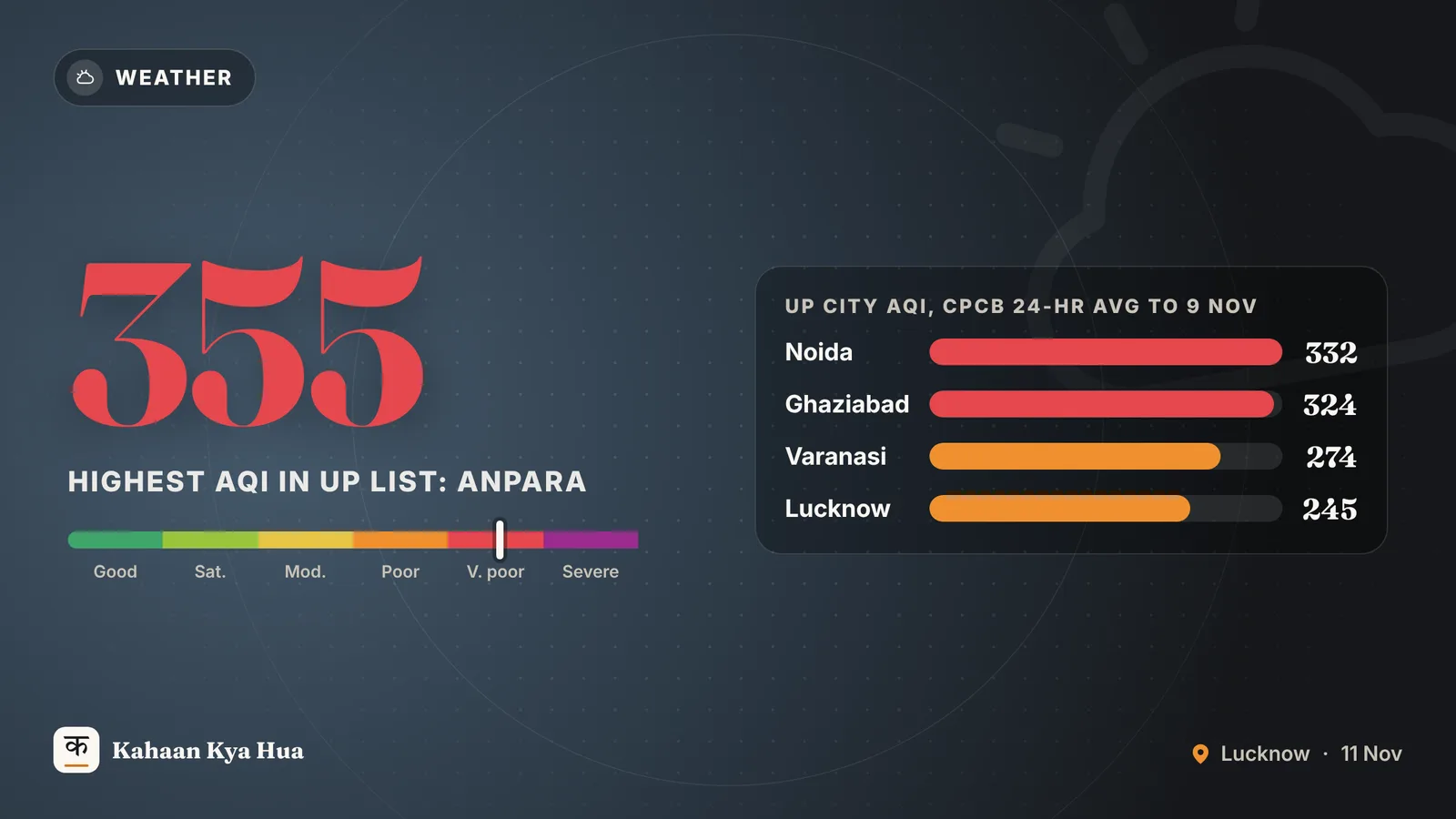
In Uttar Pradesh, The Indian Express reported that seven locations, including Noida, Ghaziabad and Khurja, recorded "very poor" air on the CPCB bulletin covering the 24 hours to 4 pm on 9 November. Anpara had the highest reading among the listed UP locations at 355, followed by Noida at 332, Khurja at 331 and Ghaziabad at 324. Baghpat, Gajraula and Bulandshahr were between 303 and 305. Varanasi (274), Meerut (269), Gorakhpur (261), Lucknow (245) and Prayagraj (241) stayed in the "poor" band.
Closer to Kanpur, Amar Ujala reported that in neighbouring Kanpur Dehat the AQI on Tuesday was between 145 and 166, which the paper described as unhealthy, with morning and evening smog and low visibility. Traders estimated about Rs 2 crore of firecracker sales in the district over Diwali.
Fog and visibility
The India Meteorological Department (IMD) said visibility fell to zero in Varanasi on Monday, to 100 metres in Bareilly and to 300 metres in Lucknow. It has forecast light to moderate fog in the mornings and haze through the day for the next two to three days. For Delhi, it has forecast moderate fog on 11 November, with a maximum of around 28 degrees Celsius. Hindi reports on the IMD outlook say no rain is expected in Uttar Pradesh until about 16 November, which means there is no quick wash-out of pollutants on the cards.
Why your phone shows a different number
On Tuesday the CPCB explained why official readings top out at 500 while some private apps showed figures as high as 1,800 in Delhi on Diwali night, as the Times of India reported. The board said:
- The 500 ceiling is a deliberate feature of the national index, in line with the US EPA scale. Anything above it is still "Severe" and the health advice does not change.
- The official AQI uses 24-hour rolling averages, so it reflects sustained exposure.
- Private apps often use low-cost sensors and show hourly spikes, so they can read very high during a short peak and lower afterwards.
The practical point: use the category, not just the number. The CPCB bands are 0 to 50 good, 51 to 100 satisfactory, 101 to 200 moderate, 201 to 300 poor, 301 to 400 very poor and 401 to 500 severe.
What to do
- Children, older people and people with asthma should limit outdoor activity in the early morning and evening, when haze and fog are thickest. A doctor from a Kanpur-area medical college quoted by Amar Ujala advised sensitive groups to wear a mask outdoors.
- Drive slowly with fog lights on during early hours, especially on expressways where visibility can drop sharply.
- Keep windows closed during peak haze hours and avoid burning waste or leaves.
- Check the CPCB's official bulletin or the Sameer app for your city rather than relying on one private app.
What next
The IMD expects fog and haze to continue for the next few days. Air quality should improve only gradually unless winds pick up, and the cooler nights now arriving can trap pollutants close to the ground. We will update this story if the forecast changes.