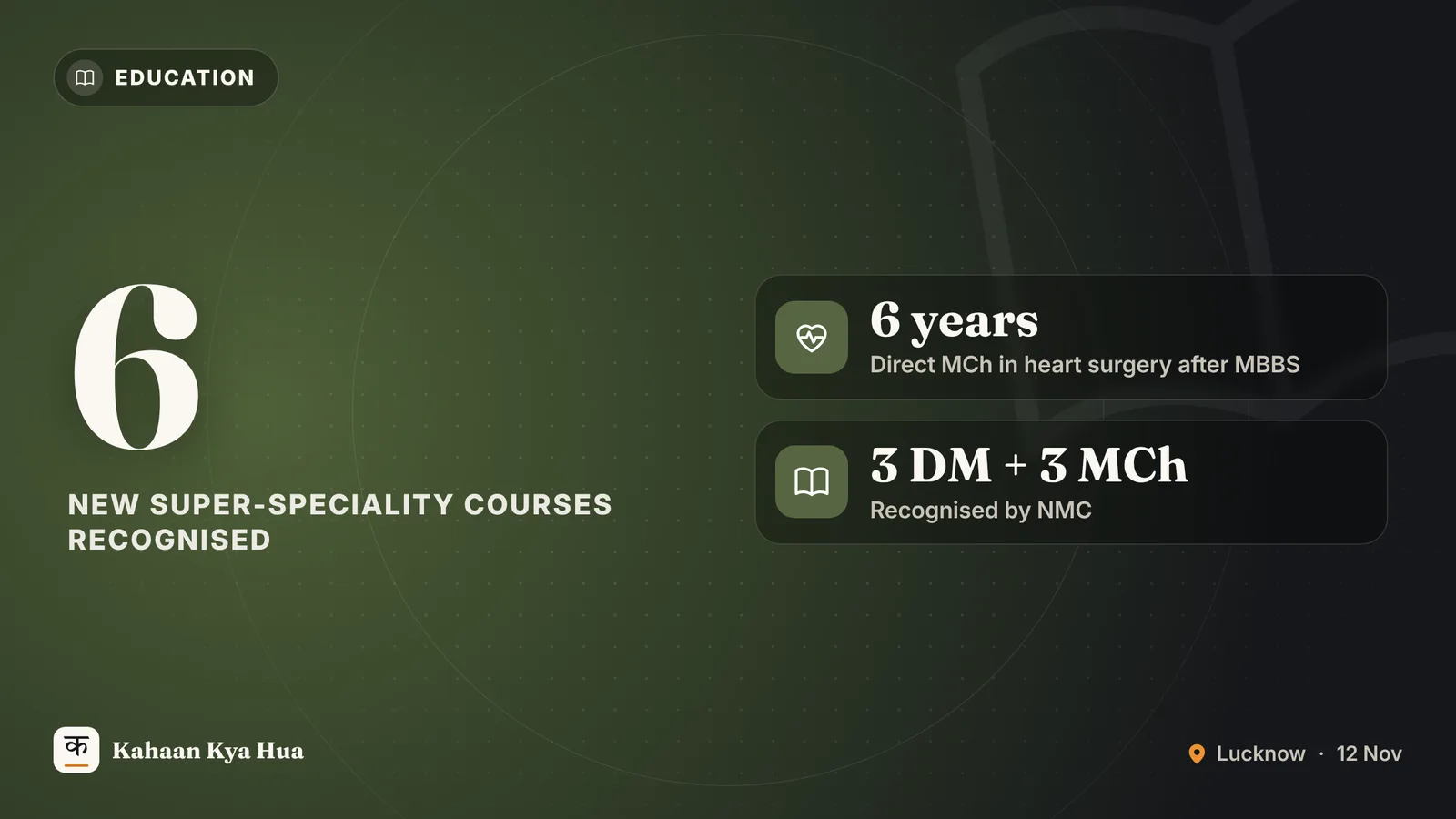
The Sanjay Gandhi Postgraduate Institute of Medical Sciences (SGPGI) in Lucknow has received recognition from the National Medical Commission (NMC) for six new super-speciality medical programmes. News of the approval emerged on Wednesday, 11 November 2026, and the institute describes several of the courses as firsts for Uttar Pradesh or for the country.
Which six courses have been recognised?
Three are three-year DM (Doctorate of Medicine) programmes: haematopathology, maternal and foetal medicine, and pain medicine. The other three are six-year programmes: radiation therapy and oncology, an MCh in cardiovascular and thoracic surgery (CVTS), and an MCh in paediatric urology.
According to Hindustan Times and The Times of India, institute director Prof RK Dhiman said the DM in haematopathology will make SGPGI the first institute in Uttar Pradesh to offer the course. It is meant to address a shortage of specialists with a pathology background who can diagnose and manage complex blood disorders, including thalassaemia and haemophilia, and to strengthen bone marrow transplant services. SGPGI's haematology department has already been running a DM in clinical haematology since 2011.
What changes for heart surgery training?
The conventional route to becoming a cardiac surgeon requires an MBBS, then a three-year MS in general surgery, then a further super-speciality course. The new six-year MCh in CVTS lets medical graduates enter super-speciality training straight after MBBS. Bhaskar English reports, citing the institute, that this is the first time such a six-year course is being launched in the country.
What will the foetal medicine and pain courses cover?
The three-year DM in maternal and foetal medicine will train specialists in prenatal diagnosis, foetal therapy, structural abnormalities, foetal blood disorders and complicated maternal conditions. The reports describe the approach as treating the unborn child as a patient in its own right. The Times of India calls it India's first DM programme in this field. The institute says it may help reduce maternal deaths, stillbirths and newborn deaths over time.
The DM in pain medicine will cover medicines as well as advanced interventional procedures. Bhaskar English quotes the institute's press release as saying around 30 per cent of adults in India live with chronic pain and nearly 80 per cent of those with severe pain do not receive appropriate treatment. These are the institute's figures and we have not independently verified them.
What about cancer and children's urology?
The six-year course in radiation therapy and oncology will train doctors in cancer diagnosis, staging, radiation treatment, chemotherapy, rehabilitation and palliative care. The six-year MCh in paediatric urology builds on SGPGI's history: the institute set up what it says was India's first dedicated department of paediatric urology. The course will prepare specialists to manage congenital and acquired urological disorders in infants, children and adolescents.
Why does it matter for patients and students?
Super-specialists are scarce outside the big metros, and Uttar Pradesh's patients often travel to Lucknow or Delhi for such care. More training seats at a government institute mean more doctors who can eventually work in medical colleges and district hospitals across the state. For students, the direct CVTS route shortens the road to heart surgery by about three years compared with the older MBBS-MS-MCh path.
Bhaskar English also notes that Prof Dhiman is a member of the committee of the NMC's Postgraduate Medical Education Board that grants recognition to new courses.
What happens next?
The reports do not give the number of seats in each course or the date from which admissions will open. Aspirants should wait for the institute's official notice and the national entrance process rather than rely on forwarded messages. We will update this story when SGPGI announces seats and the admission schedule.