The Allahabad High Court has pushed the Centre to answer a problem that thousands of cyber-fraud victims know well: your bank account is frozen because criminals used your details, and nobody tells you when it will open again. A report on 12 November 2026 says the Lucknow bench has asked the concerned ministries and departments to come up with a solution.
What the court did
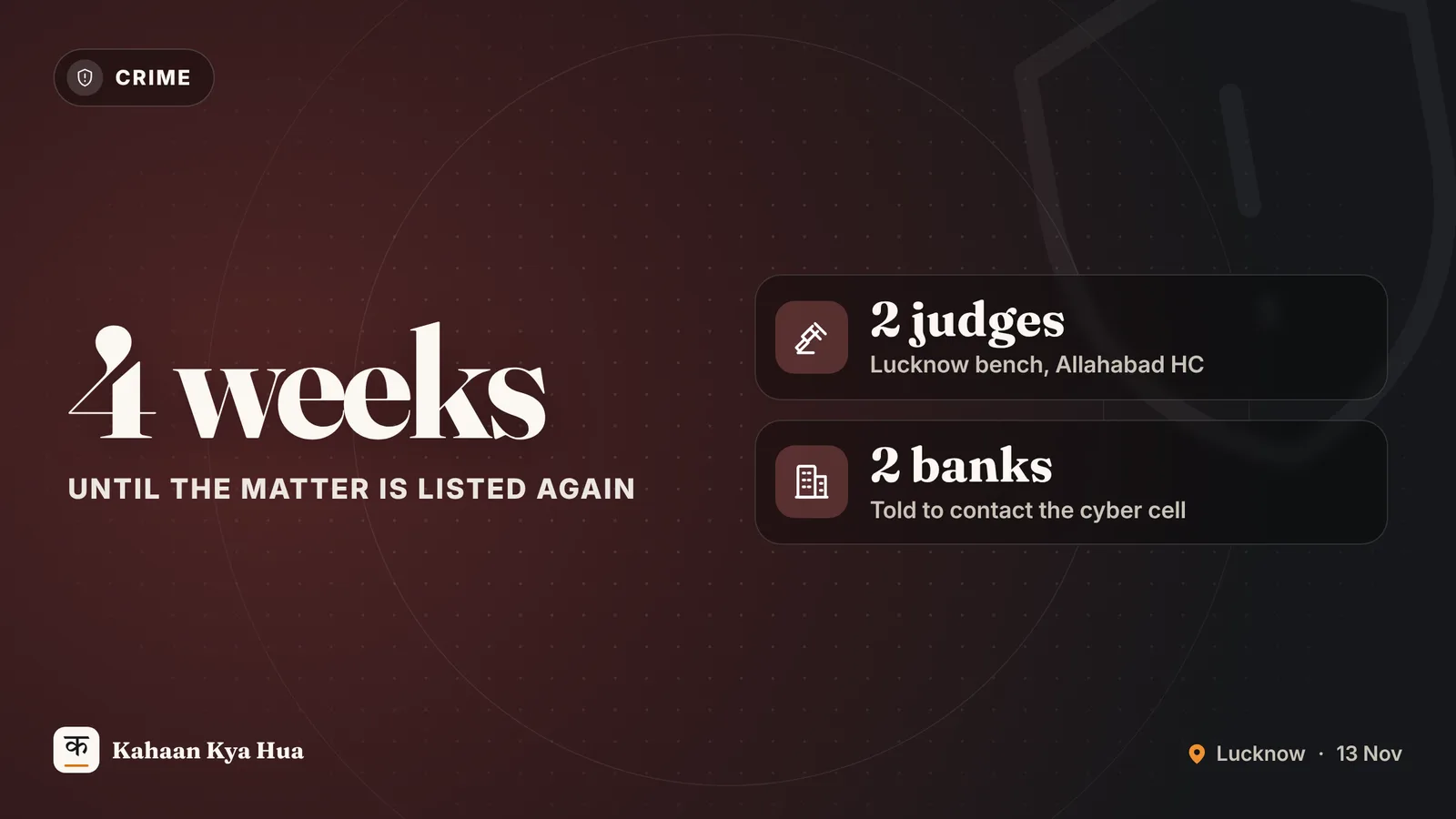
A division bench of Justice Rajan Roy and Justice Subhash Vidyarthi was hearing a petition filed by a builder. According to Hindustan Times and Live Law, the court made the Union of India, through the Ministry of Home Affairs, a respondent in the case. The bench observed that there has to be a mechanism to resolve such cases. In its written remarks it said it wanted the ministries and departments concerned to find a solution where "gullible citizens" are caught in a trap by cybercriminals and their accounts "remain freezed indefinitely".
Assistant Solicitor General SB Pandey accepted notice for the Union and was directed to seek instructions and file an affidavit.
The builder's case
The petitioner told the court that his son had mistakenly clicked on a link sent by a cybercriminal and shared his Aadhaar card details and other information. The petitioner says the fraudster then used those details to commit further cybercrimes and cheat other people through bank transactions. As a result, all of the petitioner's accounts were frozen and he cannot run his business. He says he had himself lodged an FIR in 2020.
Earlier, in proceedings seeking the unfreezing of one savings account, the High Court had allowed him to apply to UIDAI for a new Aadhaar card and cancellation of the old one. Fresh biometrics were taken and his mobile number was changed. His difficulty did not end, because his existing accounts stayed frozen.
What the banks said
Counsel for two of the banks told the court that the bank had contacted the cyber cell and, as it received no instructions from it, the freeze had been discontinued. The court nevertheless directed the two banks to contact the relevant cyber cell officials, find out the status of the pending criminal cases, and act in accordance with law. It also told the banks to "make all endeavour to resolve the matter".
The petitioner was directed to add the State of Uttar Pradesh, through the additional chief secretary or principal secretary (home), the Police Commissioner of Lucknow and the station house officer of Vibhuti Khand police station, as parties to the case.
Why it matters
Bank accounts are routinely frozen by investigators when money from a cyber fraud passes through them. The order does not change that practice, and the court has not decided who is right in this particular dispute. What it does is flag a gap: a person whose identity was misused can be treated like a suspect for years, while the case that froze the account moves slowly. For a trader or builder, that can mean no salaries, no GST payments and no loan repayments.
The bench's remark is aimed at the Centre because policy on cybercrime reporting, account freezes and national portals sits with central agencies, even though the police action itself is local.
What readers can take from it
The case is a reminder of the usual safeguards. Do not click links from unknown senders. Do not share Aadhaar details or OTPs. If your Aadhaar or phone number has been misused, file a complaint promptly and keep the acknowledgement, because the court noted that the petitioner's own FIR was lodged in 2020 and the freeze still continued.
What happens next
The High Court has directed that the matter be listed after four weeks as a fresh matter. By then the Union is expected to have instructions and an affidavit ready, and the banks are expected to have spoken to the cyber cell. Any solution that comes out of the Centre, whether a time limit on freezes or a fast route to unfreeze victims' accounts, would apply well beyond this one builder.
This report is based on coverage by Hindustan Times and Live Law of the court's observations. It is not legal advice, and it does not name the petitioner.