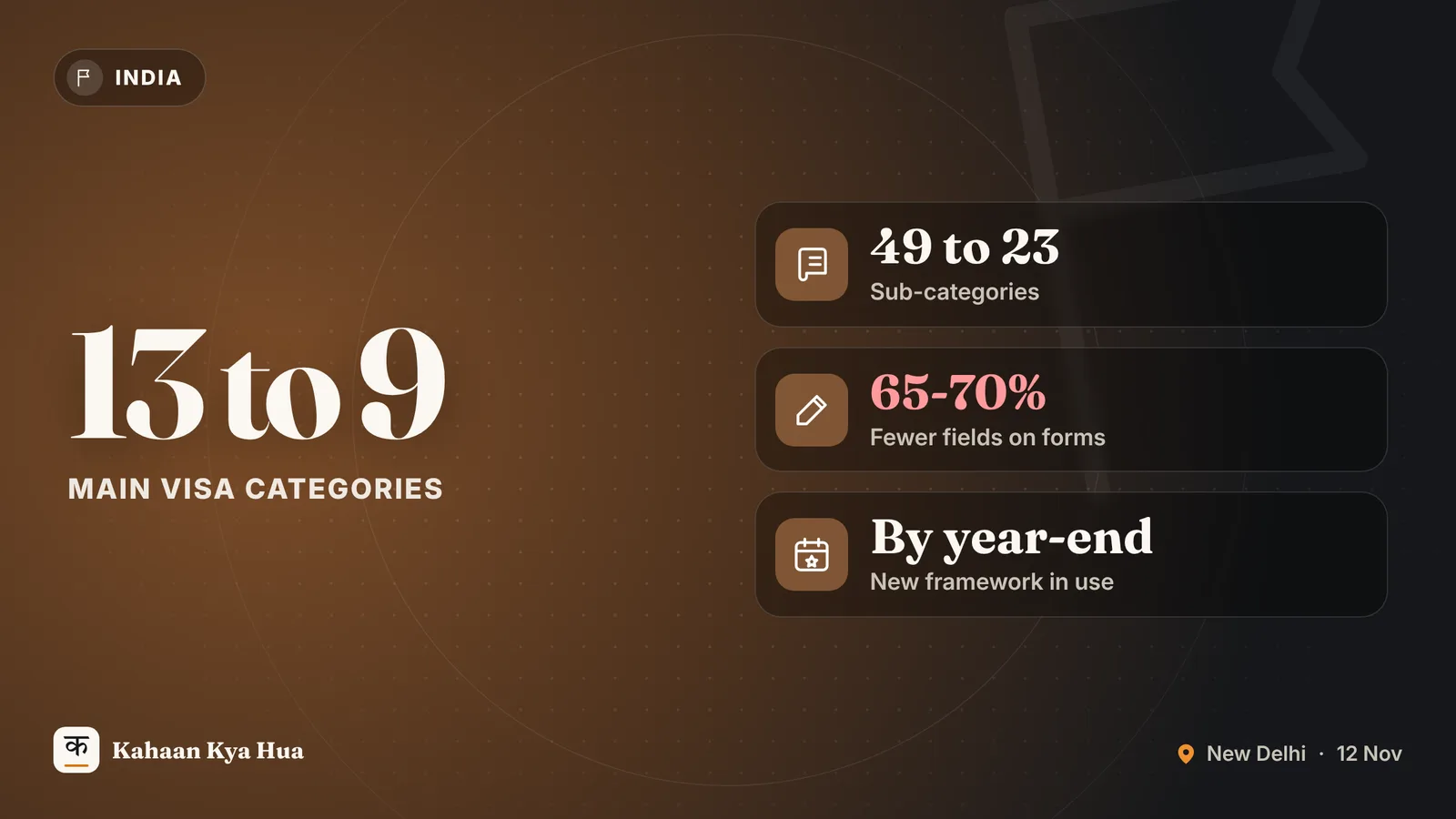
The Ministry of Home Affairs (MHA) on Wednesday, 11 November 2026, announced a simpler visa system for foreign nationals visiting India. The number of main visa categories falls from 13 to nine, sub-categories from 49 to 23, and the fields on visa application forms are cut by 65 to 70 per cent. The ministry says the changes are meant to boost foreign tourist arrivals, medical value travel and the number of foreign students.
What exactly has changed?
According to the MHA statement, reported by Hindustan Times and The Indian Express, the new framework merges overlapping categories so that visitors can more easily find the right one. The government said it studied the visa systems of developed countries and global standards before making the changes. Application forms across all 23 sub-categories have been shortened, while the information needed for processing has been kept.
The exercise follows an earlier one in October 2025, when main categories were reduced from 22 to 13 and sub-categories from 63 to 49. The two outlets differ on timing: The Indian Express also mentions a reduction from 13 to nine on 27 August, while Hindustan Times presents the cut as the ministry's Wednesday announcement. We have therefore reported the 11 November announcement and not a separate earlier date.
What happens to the tourist visa?
The old Tourist Visa is now called the Visitor Visa, to show that it covers more than tourism. It has two sub-categories.
- V-1: for short-term activities such as business meetings, medical consultations, wellness retreats, short-duration medical treatment, and short courses in Indian languages, music, art and craft. It is valid for 30 days with multiple entries.
- V-2: for longer visits, with validity of one, five or 10 years as specified. It covers everything V-1 does and also mountaineering, for which a six-month multiple-entry visa will be granted.
What about business, student and medical visas?
Business visas are now B-1 and B-2. B-1 is for long-term, licence-based activities, including foreign nationals who want to set up industrial or business ventures in India. B-2 is for short-term, contract-based work such as production investment business, conferences, sports, performing arts and films.
There is a specific provision for foreign specialists, engineers and technical staff hired by Indian companies for tasks like installation and commissioning, quality checks, essential maintenance, IT and ERP ramp-up, training and technical support. They can get a Production Investment Business Visa under B-2 through the e-visa platform. This was earlier called the e-B4 visa.
Student visas are now S-1, for school, graduate and postgraduate education, and S-2, for PhD and research scholars, visiting faculty, internships, exchange students and similar academic activity. Students enrolled through the Study in India portal may get an e-S1 visa valid for up to five years or the length of the course, whichever is shorter, with multiple entries.
Under the revised medical framework, as reported by The Indian Express, M-1 visas for treatment outside AYUSH systems and M-3 visas for AYUSH treatment, including their electronic versions, will ordinarily be issued for one year with multiple entries. Attendants are eligible for M-2 and M-4 visas respectively.
Who can use the e-Visa?
The e-Visa facility currently covers nationals of 172 countries under 13 sub-categories, according to The Indian Express.
Why does it matter?
For a tourist or patient planning a trip, fewer categories and shorter forms mean less confusion about which visa to apply for and fewer questions to answer. For Indian companies bringing in foreign technicians, a clear route under B-2 through the e-visa platform may save time. For colleges and hospitals trying to attract foreign students and patients, a simpler system is an easier pitch.
A visa is still a permission, not a guarantee of entry. We would caution readers that the ministry's statement describes the application framework, and entry at the border remains subject to the usual checks.
What next
The MHA is updating its IT systems, and visas will be granted under the revised framework by the end of this year, according to the ministry's statement. Until then, applicants should use the existing process and check the official government visa portal for updated forms and category names before applying.