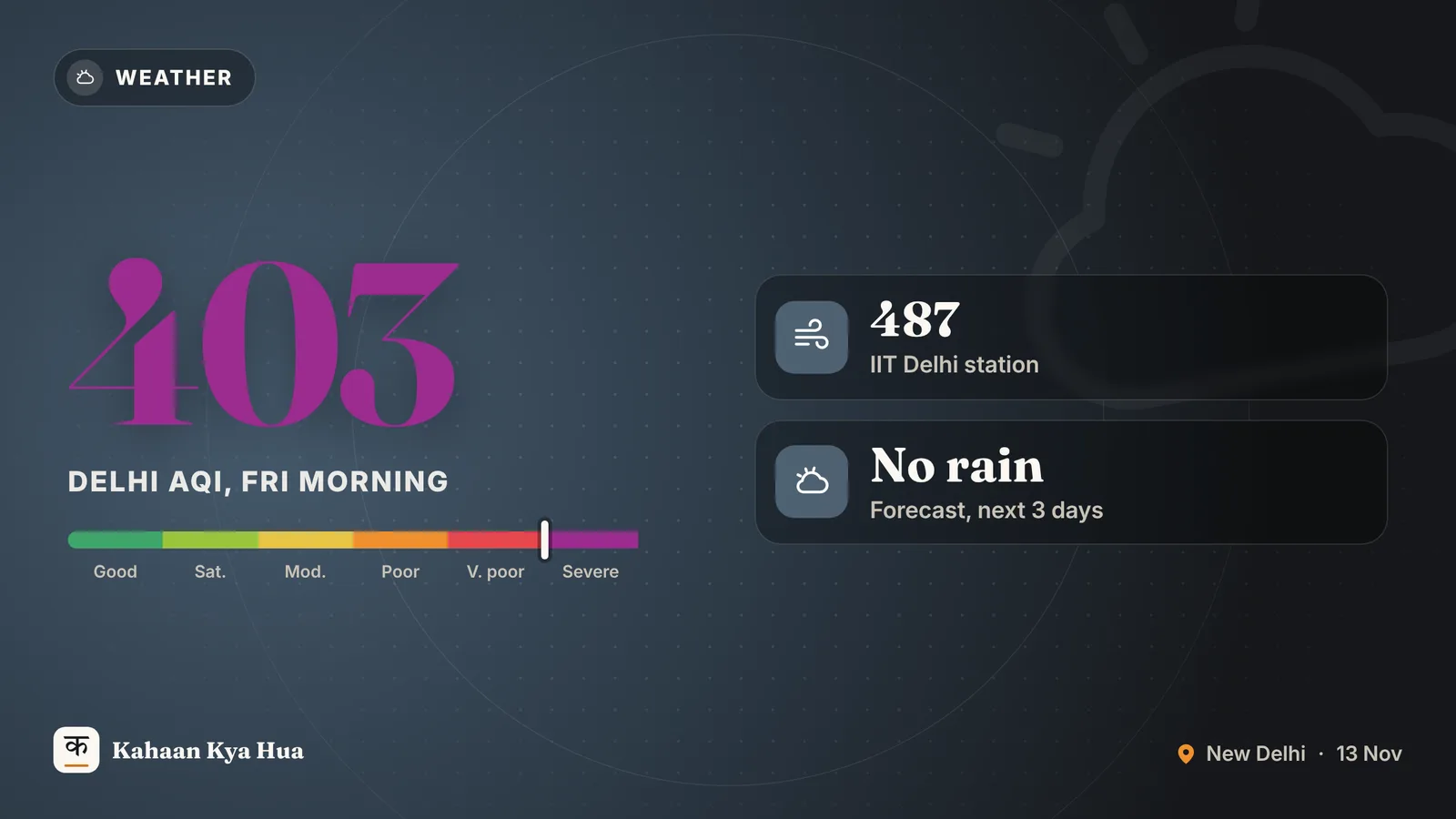
Delhi's air slid into the "severe" band on Friday morning, 13 November 2026, four days after Diwali, with several monitoring stations crossing 400 on the Air Quality Index and IIT Delhi touching 487. Forecasts show little relief for at least the next three days.
What the numbers say
Times Now reported on Friday that the city-wide AQI had crossed 400 and was at about 403, the lower edge of the severe category. Among the stations it listed, IIT Delhi stood at 487 and Chandni Chowk at 476, with Vasundhara Enclave at 429, Chhawla at 427, Wazirpur at 425, Anand Vihar at 417 and Rohini at 411.
The worsening was sharp. The Central Pollution Control Board's AQI for Delhi, which is a rolling 24-hour average, was 299 on Tuesday and 313 on Wednesday. According to a Hindustan Times analysis of official data, it stood at 350 in the 4 pm bulletin on Thursday and climbed to 387 by 10 pm, with 21 of the 58 reporting stations already above 400. A day earlier only one station was in that zone in the evening, and none on Tuesday. The Indian Express also put Thursday's reading at 350, with Gurugram at 320 and Noida at 311.
Why it got worse so fast
Hindustan Times said the amount of fine particles (PM2.5) more than doubled in 24 hours to 244 micrograms per cubic metre by 6 pm on Thursday, about four times the national standard. Two things happened together, its analysis found. First, the layer of air in which pollution mixes and thins shrank to roughly 400 metres on Thursday afternoon, from about 1,400 metres on Tuesday. Second, the north-westerly wind that carries smoke from farm fires in Punjab and Haryana, which had been slack since Diwali, was blowing above the city again.
Because the air stayed warm, damp and almost still, the usual afternoon clearing did not happen. Visibility at Safdarjung airfield fell to 800 metres by 3.30 pm on Thursday, against 2,500 metres at the same hour on Wednesday.
Where the pollution is coming from
Indian Express, citing the Indian Institute of Tropical Meteorology (IITM), said firecrackers contributed only about 7 per cent of Delhi's PM2.5 on Thursday. Biomass burning and secondary organic aerosols, which form in the air when gases from vehicles and fires react in sunlight, each contributed about 25 per cent. Vehicles added about 17 per cent and mixed combustion, such as small industries and household burning, about 11 per cent.
On stubble burning, the Indian Agricultural Research Institute (IARI) detected 339 fire events across six states on Thursday: 182 in Madhya Pradesh, 68 in Uttar Pradesh, 54 in Punjab, 31 in Rajasthan and 4 in Haryana, and none in Delhi. IARI cautioned that cloud cover over parts of the north was blocking satellite detection. Between 15 September and 12 November this season, 10,805 events were counted, the lowest since monitoring began and 24.3 per cent below last year, though Punjab's 5,571 fires were 19.5 per cent higher than in 2025.
What to expect
The India Meteorological Department (IMD) has warned of moderate to shallow fog in parts of Delhi on Friday morning, which can cut visibility for early commuters. HT reported that the IMD forecast shows no rain and light surface winds of 5 to 10 km/h in the mornings and evenings over the next three days, with the first stronger afternoon wind of 15 to 20 km/h not expected until the weekend. According to Indian Express, skies will be partly cloudy from 13 to 15 November with mist or shallow fog in the mornings, and night temperatures will fall by 3 to 5 degrees between 16 and 19 November, reaching 13 to 15 degrees Celsius by 18 November. Colder nights usually make pollution settle closer to the ground.
What residents can do
Times Now reported that people, especially children, older people and those with breathing or heart conditions, are advised to limit long outdoor activity and avoid strenuous exercise outside. Drivers should slow down in the morning fog.
Note that outlets report different figures because some quote the 24-hour CPCB average, some single stations and some a particular hour. Check the CPCB's official bulletin for the latest reading.