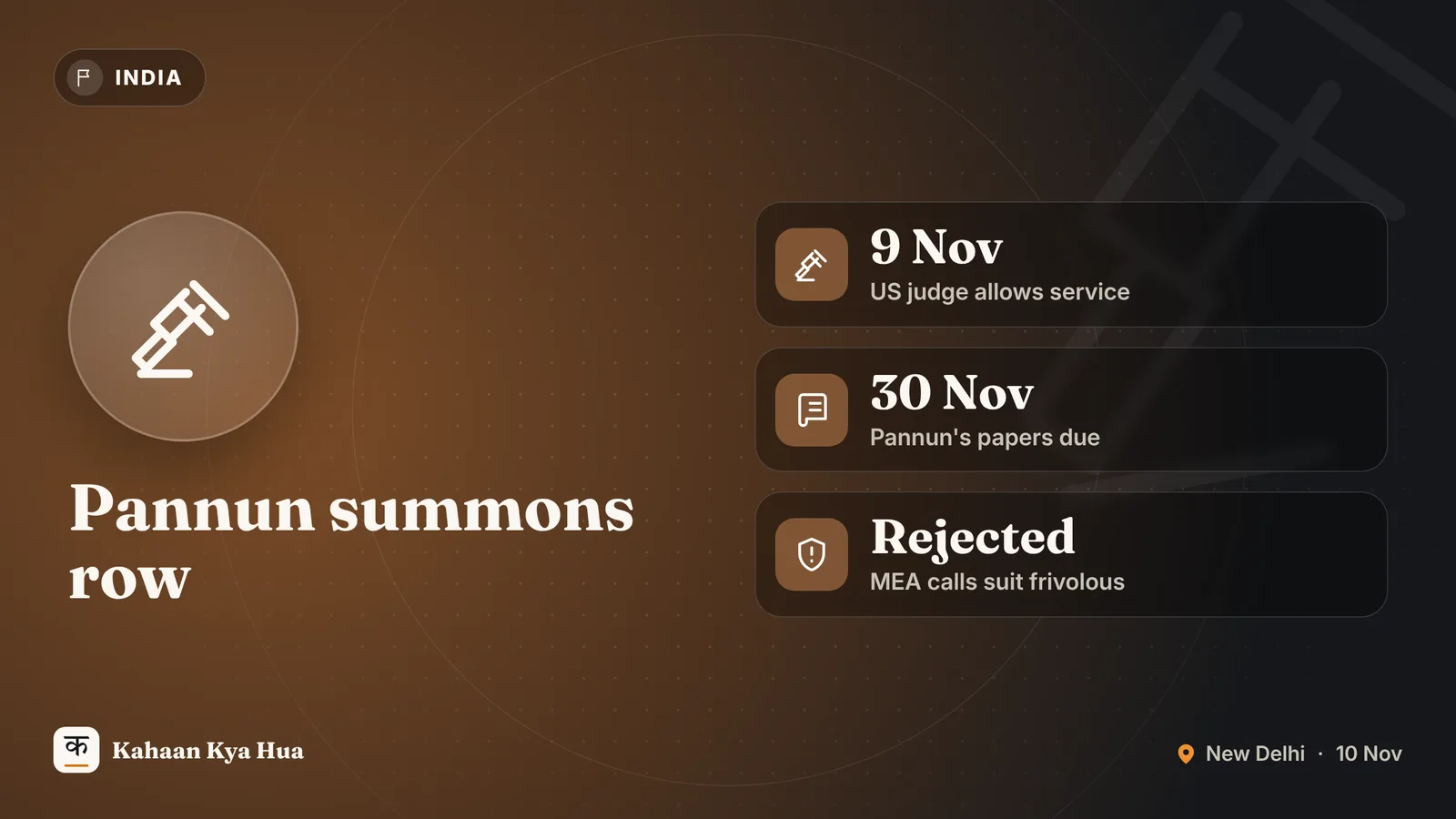
India has rejected a US court order that lets Khalistani separatist Gurpatwant Singh Pannun serve a civil lawsuit on National Security Adviser Ajit Doval and a former chief of the Research and Analysis Wing. The Ministry of External Affairs (MEA) said on Tuesday, 10 November 2026, that the lawsuit is "frivolous" and that any such papers must travel through the proper legal channel.
What the US court allowed
On Monday, 9 November, US District Judge Katherine Polk Failla allowed Pannun to serve his civil complaint on Doval and former R&AW chief Samant Goel through Indian judicial channels. The order came after the US State Department told the court that it had delivered the notice for the two officials to the Indian Embassy in Washington. The Hindu reports that the certificate of submission was signed and dated 9 October 2026.
The State Department added a footnote saying that the delivery did not mean it was taking a position on the case, and that it was acting on a legal obligation.
The judge also set homework for Pannun. By 30 November he has to prepare a set of documents, including the summons addressed to the two officials, details of Indian law and procedure and the route by which the summons would travel, and records of earlier attempts to serve them under the Hague Convention.
India's response
MEA spokesperson Randhir Jaiswal said at the weekly briefing that India rejects the "fabricated and malicious attacks" on its high officials, as well as "frivolous lawsuits". He added that requests to serve judicial documents in India can only be routed through the designated central authority, the Ministry of Law and Justice, and not through the Embassy or the MEA.
The Hindu reports that the ministry signalled it was unconcerned by the development. The Times of India describes Pannun as a designated terrorist in India's view; The Hindu says he is wanted in India on terror charges.
How the lawsuit is linked to the 2023 plot case
Pannun's civil case is separate from, but linked to, a US criminal case. US prosecutors say a plot was hatched in 2023 to hire a hitman to kill Pannun in New York. A US Drug Enforcement Administration informant had pointed to Indian businessman Nikhil Gupta, who was arrested in the Czech Republic and extradited to the US. According to The Hindu, Gupta has since pleaded guilty to all charges and his sentencing is set for 20 November.
The indictment also referred to Vikash Yadav, described as associated with R&AW. The Hindu reports that Yadav was arrested in Delhi in December 2023 on separate charges and got bail in April 2024. The Times of India notes that India set up a committee to look into the concerns raised by Washington.
The Hindu adds that US investigators, in this case and in a similar one over the killing of Harjeet Singh Nijjar in Canada, appear to have dropped earlier suggestions about the involvement of more senior officials. Pannun, however, has continued to ask the court to summon Doval and Goel. He tried to serve Doval in February 2025 when the NSA travelled to Washington with Prime Minister Narendra Modi, but the attempt failed.
Why the procedure matters
The dispute is not about whether the allegations are true; no court has decided that in this civil case. It is about how legal papers cross borders. India and the US are both parties to the Hague Service Convention, under which each country names a central authority to receive foreign court papers. India's position is that this authority is the Ministry of Law and Justice. A notice handed over at an embassy, India says, is not valid service.
The judge's order keeps the lawsuit moving on paper while leaving the key question open: whether the papers will ever be accepted in India.
What happens next
Pannun has until 30 November to file the documents the court asked for. Gupta's sentencing on 20 November in the criminal case may bring fresh attention to the same events. No Indian court or ministry has said it will accept the summons, and India has indicated it will not.