The Union Cabinet on Wednesday, 11 November 2026, cleared a set of decisions that touch farmers, small entrepreneurs and the national capital's skyline. Two of them matter most to household and business budgets: a much bigger fertiliser subsidy for the coming rabi season, and a five-year extension of the credit guarantee cover behind the Stand-Up India and Mudra loans.
How much more is the government spending on fertiliser?
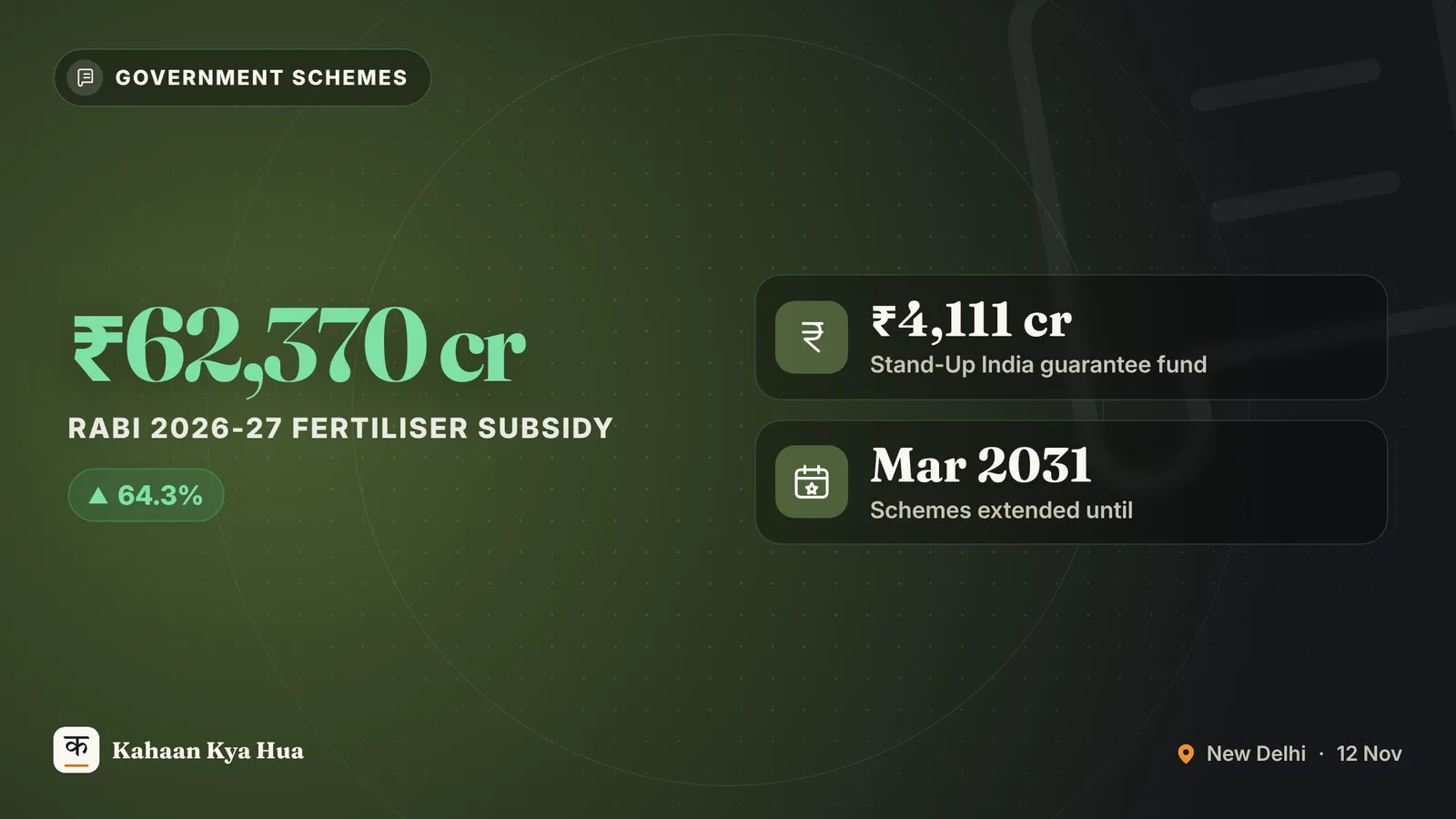
The Cabinet approved Nutrient-Based Subsidy (NBS) rates for phosphatic and potassic (P&K) fertilisers for the rabi 2026-27 season. The tentative budget requirement is about ₹62,370 crore, which is roughly ₹24,418 crore more than the ₹37,952 crore set aside for the previous season. That is a rise of about 64.3 per cent, according to Hindustan Times and NDTV's report of the official release.
Hindustan Times links the jump to disruption in international fertiliser markets after the US-Israel attacks on Iran in February, and to restrictions on shipping through the Strait of Hormuz, a key route for global fertiliser trade. The revised subsidy, the report says, takes into account trends in international prices and input costs.
Prime Minister Narendra Modi said on X that farmers have always been the government's top priority. He said the subsidy means changes in international prices will not affect farmers and that they will keep getting fertilisers at affordable and reasonable prices.
What happens to Stand-Up India?
The Cabinet also approved continuing the Stand-Up India scheme for five more years, until 31 March 2031. The scheme is meant to promote entrepreneurship among women and members of Scheduled Castes and Scheduled Tribes. According to the government's press release, as reported by Hindustan Times, it aims to help 2.5 lakh additional entrepreneurs over the next five years. Since its launch in April 2016 it has facilitated loans to more than 2.75 lakh entrepreneurs from these groups.
The Credit Guarantee Fund for Stand-Up India will get ₹4,111 crore. It will guarantee loans above ₹10 lakh and up to ₹1 crore for women and SC/ST entrepreneurs setting up greenfield enterprises, meaning new businesses rather than expansions. The target is an average of two loans per bank branch, one to a woman entrepreneur and one to an SC/ST entrepreneur.
Two terms stand out. The guarantee fee will be 0.50 per cent a year with no additional risk premium, and the guarantee cover will be raised to 85 per cent across loan sizes. In plain terms, if a borrower defaults, the guarantee fund would cover up to 85 per cent of the loss for the lender, which is meant to make banks more willing to lend without asking for collateral.
And the Mudra guarantee fund?
For the Pradhan Mantri Mudra Yojana (PMMY), the Cabinet approved ₹5,000 crore for the Micro Units fund. This credit guarantee fund is expected to support Mudra loans worth ₹12.60 lakh crore. It covers PMMY loans of up to ₹20 lakh, overdrafts of up to ₹10,000 under the Pradhan Mantri Jan Dhan Yojana, and self-help group loans of ₹10-20 lakh, all without collateral.
The annual guarantee fee will come down from 1 per cent to 0.75 per cent. The government also plans to strengthen the claim process for lenders, so that banks that lose money on a guaranteed loan get paid faster and have fewer reasons to hold back credit from micro entrepreneurs.
Other decisions the same day
The Cabinet also approved a ₹3,230 crore Yuge Yugeen Bharat National Museum in New Delhi's North and South Blocks, due by March 2031, and a ₹2,390 crore Noida Metro Aqua Line extension, which we have covered separately.
Why it matters
For farmers, the subsidy is meant to hold fertiliser prices steady during the sowing season even when global prices are volatile. The bill falls on the Union budget, so a 64 per cent jump will be watched by economists for its effect on the fiscal deficit. The report does not give a deficit estimate, and we have not seen one from the government.
For small business owners, especially women and SC/ST entrepreneurs, lower guarantee fees and higher cover could mean easier collateral-free loans. Actual access will still depend on what banks decide at branch level.
What next
The NBS rates will now be notified for the rabi season. The Stand-Up India and Mudra guarantee funds run until March 2031, and the government says it will work on the claim process for lenders. Readers should check with their bank branch for how the revised terms apply to a new loan application.