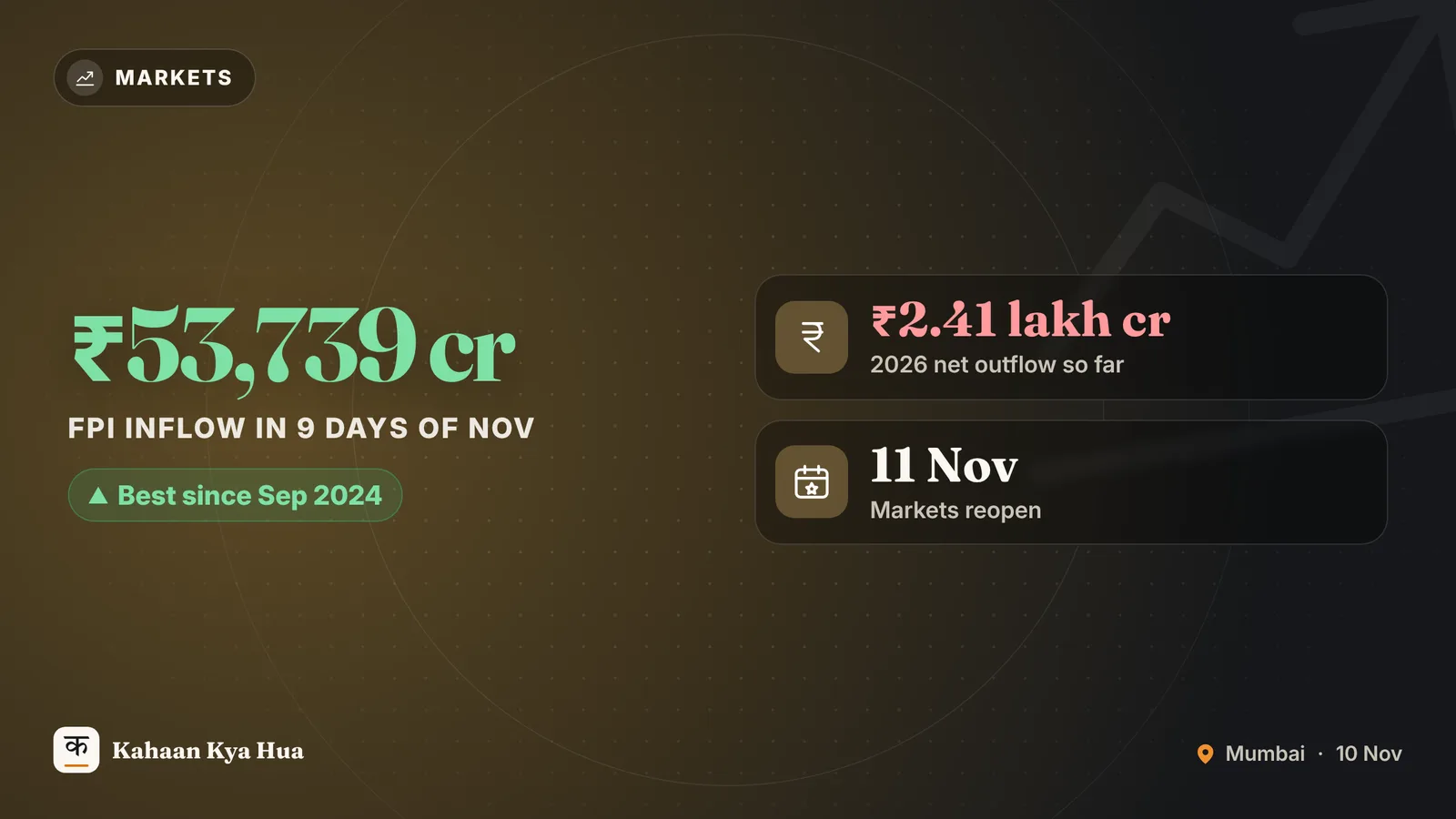
Foreign portfolio investors (FPIs) have put ₹53,739 crore into Indian shares in the first nine days of November 2026, according to NSDL data cited by Mint and Business Today. It is the biggest monthly inflow since September 2024, and it comes right after two months of heavy selling. Stock exchanges were shut on Tuesday, 10 November, for Diwali-Balipratipada and reopen on Wednesday, 11 November.
How big is the turnaround
Business Today reports that FPIs pulled out ₹70,704 crore across September and October. The November buying is larger than anything since September 2024, when they bought ₹57,724 crore.
Even so, 2026 remains a year of net selling. Mint says FPIs were net sellers in eight of the first ten months and that the cumulative net outflow for the year has narrowed to about ₹2.41 lakh crore. Business Today says that is still the highest outflow for any calendar year. The month-wise picture runs like this:
- January: outflow of ₹35,962 crore
- February: inflow of ₹22,615 crore
- March: outflow of ₹1.18 lakh crore, with selling continuing through June
- July and August: inflows of ₹20,200 crore and ₹29,631 crore
- September and October: selling again
Why money is coming back
Analysts quoted by the two outlets give several reasons.
The AI sell-off elsewhere. V K Vijayakumar, chief investment strategist at Geojit Investments, said the slide in artificial-intelligence stocks in the US, South Korea, Taiwan and Japan, driven by worries over data-centre spending, made India look attractive as a market that is not an AI bet. Jefferies noted that MSCI Korea is already down 40 per cent from its June 2026 peak, and said a moderation of the crowded AI trade could help allocations to India.
US politics and oil. Business Today links the shift to the US midterm election result, which investors read as a sign of tighter oversight of AI and data-centre spending and of the Iran war, and to a pullback in oil prices. SBI Securities said this has had a clearly positive effect on sentiment towards rupee assets.
Tax relief hopes. Manoj Purohit of BDO India told Mint that expectations of friendlier capital-market taxation have made foreign investors reassess their exposure. Industry bodies have asked for relief on the 12.5 per cent long-term capital gains tax for foreign investors and for a rationalised Securities Transaction Tax. Mint reports positive signals from the Finance Ministry about revisiting the framework in the Union Budget 2027. Nothing has been announced, so this is expectation, not policy.
Earnings and valuations. Analysts also cite improving corporate earnings and more reasonable large-cap valuations. Foreign buying has focused on heavyweights in financial services, IT, automobiles and telecom, according to Mint.
What it did to the market
Vijayakumar said last week saw a sharp reversal in institutional behaviour: FPIs turned aggressive buyers while domestic institutions were net sellers on every trading day. In his view the buying set off a short squeeze that pushed the Nifty up 7.58 per cent in a week. His own count of November FPI inflows, ₹45,970 crore, is lower than the NSDL figure, so numbers differ depending on the source and the cut-off date.
Why it matters to ordinary investors
Foreign flows move index heavyweights, so they affect the value of index funds and many mutual funds that hold them. They also influence the rupee. A report from The Tribune and Economic Times' CFO site, however, says the RBI's large net short dollar position, about $239 billion in forwards, may cap rupee gains despite the inflows.
The risks that remain
PGIM India Mutual Fund's Vinay Paharia said near-term challenges include geopolitics, crude and hardening interest rates, though he thinks much of this is already priced in. SBI Securities warned that the Iran war stalemate has no clear direction and that the risk of a reversal in yields is alive, especially because the domestic inflation estimates assume today's crude prices.
What to watch next
Traders will look at how markets react when they reopen on Wednesday, whether the inflows continue through the rest of November, and whether the Budget 2027 tax discussion turns into a formal proposal. Foreign flows can reverse as quickly as they arrived, so one strong month does not by itself mean the year's selling is over.