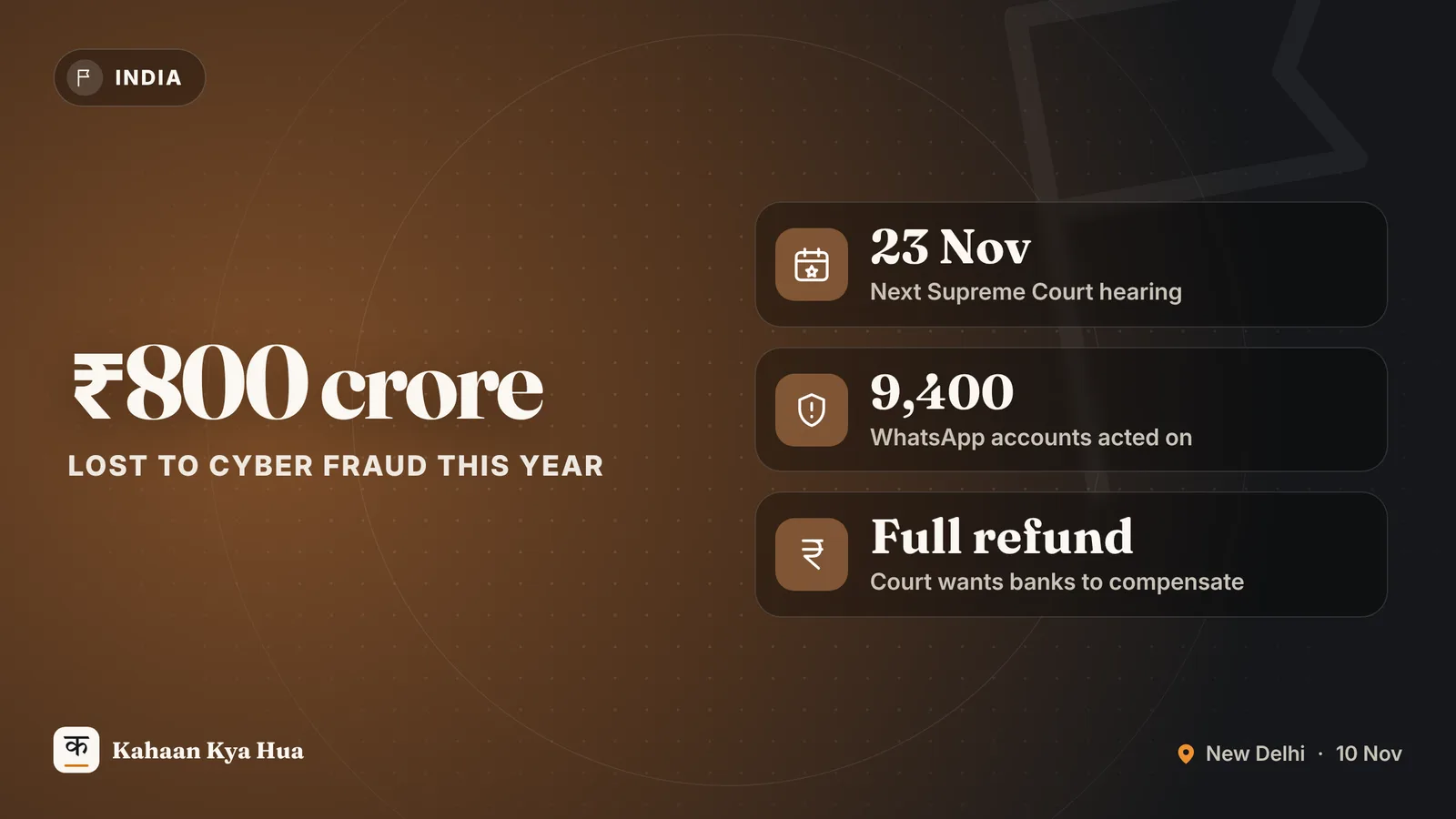
The Supreme Court has asked WhatsApp and other messaging and social platforms to tell it, in writing, what they plan to do to stop "digital arrest" scams. The direction comes in an order that was uploaded to the court's website on 10 November 2026 for a hearing held on 29 October. The case will come up again on 23 November 2026.
What the court has ordered
The suo motu case is titled "In Re: Victims of Digital Arrest Related to Forged Documents". A bench headed by Chief Justice of India Surya Kant, with Justices Joymalya Bagchi and V Mohana, has told WhatsApp LLC and other intermediaries to put their proposed measures before the court and, at the same time, send them to the Indian Cyber Crime Coordination Centre (I4C).
Senior advocate Kapil Sibal, appearing for WhatsApp, told the bench that the platform had already acted against about 9,400 accounts. According to the reports, he said WhatsApp would file an affidavit listing the steps taken and was building software to spot suspicious accounts and warn users.
Banks under the spotlight
The harder message in the order is for banks. The bench repeated that the Reserve Bank of India's proposed rules must require financial institutions to compensate victims of digital arrest scams and other cyber frauds. The compensation, it said, should be not less than the amount the customer lost, where it is established that the fraud happened because the bank did not exercise due diligence in preventing or reporting it.
The Chief Justice described banks as a "protective umbrella" for vulnerable customers and asked why they cannot step in when an account suddenly sends out an unusually large sum that does not match its history. The order lists safeguards the court has pressed for before: pausing unusual or suspicious transactions, informing the nearest police station automatically, and physically verifying the transaction afterwards.
The court also asked the RBI to give it a list of all authorised financial institutions on the next date. It said it would first examine the RBI's proposed Know Your Customer Amendment Directions, 2026 before the regulatory process moves ahead. As reported, those directions are meant to be notified by 30 November and to come into force by 31 December.
Police and the Centre
All states and Union territories have been told to file reports on the FIRs registered in digital arrest cases and the investigations that followed. The agencies must also give suggestions on preventing, detecting and prosecuting these offences. The DGPs of every state and Union territory have been asked to make sure this is done, and the reports go to the inter-departmental committee that coordinates the government's response.
Attorney General R Venkataramani, appearing for the Centre, told the bench that a lot of work has been done to improve the detection of suspicious transactions inside the banking system.
The numbers behind the push
The bench noted that cybercrime cases had fallen by about 50 per cent, yet victims have still lost roughly ₹800 crore so far this year. That gap, the court indicated, is why it wants enforceable provisions for compensation, preventive intervention and institutional accountability, not just advisories.
What a "digital arrest" scam looks like
In these scams a caller poses as a police officer, a customs or narcotics official or a court officer and tells the victim that they are under "arrest" over a parcel, a SIM card or a money-laundering case. The victim is kept on a video call for hours or days and pressed to transfer money to a "safe" account. No Indian agency arrests anyone over a video call or asks for money to close a case.
What you can do
If you get such a call, cut it and do not transfer money. Call 1930, the national cybercrime helpline, or report at cybercrime.gov.in as soon as possible, because quick reporting gives the bank a better chance of freezing the money.
What happens next
The next hearing on 23 November will show how far WhatsApp, other platforms and the RBI have got with their proposals. If the court's compensation condition is written into the final RBI rules, banks could be liable for losses when their checks fail.