Air quality in many Uttar Pradesh cities worsened sharply after Diwali, with western and central districts recording 'very poor' readings on Monday, 9 November 2026. Fireworks added to a pollution load that was already building before the festival, and calm, stagnant weather helped trap the smoke close to the ground.
What the official numbers show
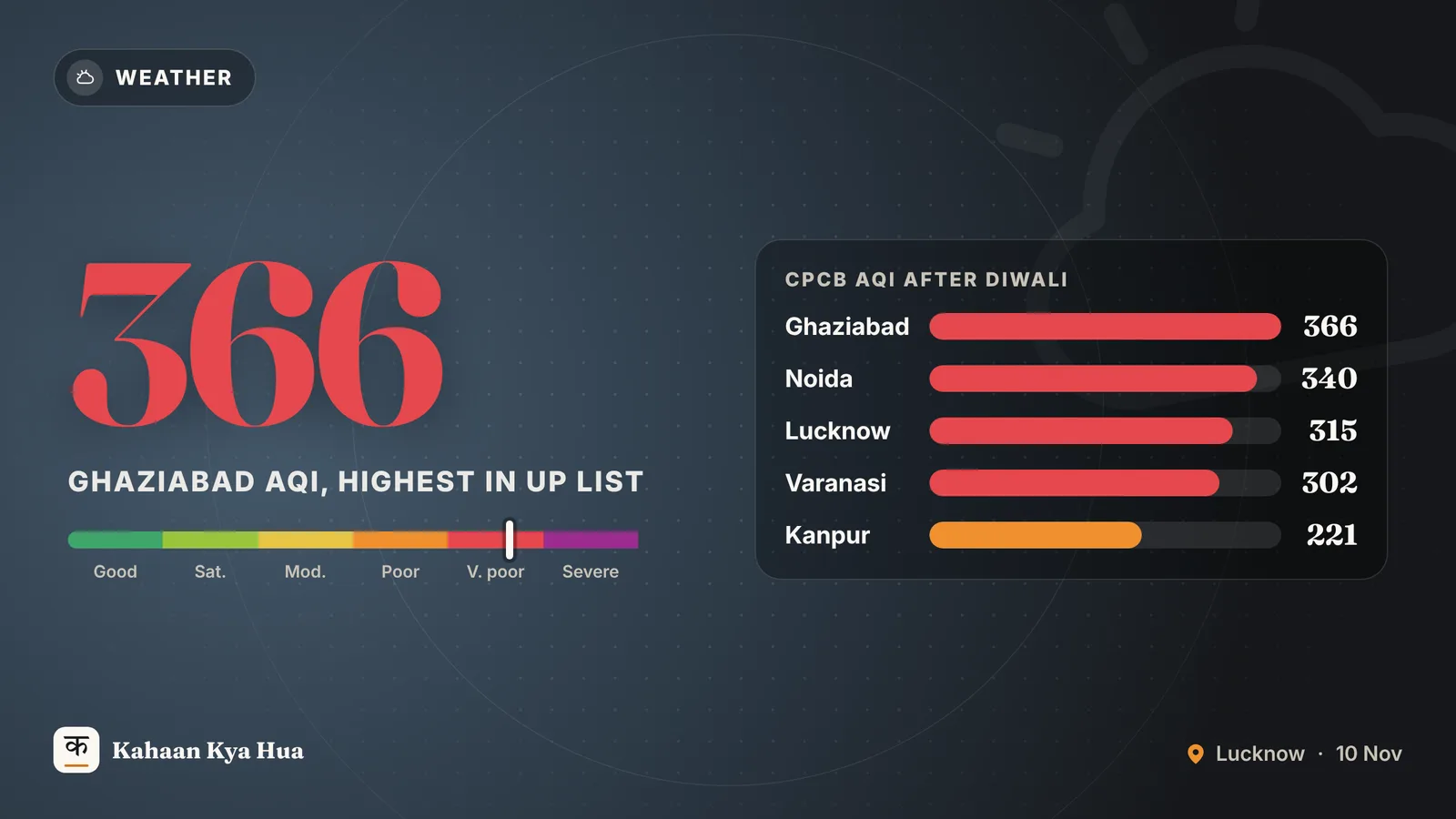
Using Central Pollution Control Board (CPCB) figures reported by the Free Press Journal, Ghaziabad recorded an AQI of 366, Noida 340, Varanasi 302 and Bulandshahr 371. Greater Noida stood at 293, Gorakhpur at 261, Hapur at 255 and Kanpur at 221. On the CPCB scale, 201 to 300 is 'poor', 301 to 400 is 'very poor' and 401 to 500 is 'severe'.
Business Today, also quoting CPCB data, put Noida at 341, Greater Noida at 287 and Ghaziabad at 357 on Monday, and noted that Lucknow and Kanpur also reported elevated pollution. The small differences between outlets come from the time of the reading and the daily bulletin used. Noida's average had jumped to 248 on 2 November from 106 a day earlier, so the build-up began well before Diwali night.
Lucknow and the central districts
Lucknow's air was already 'poor' before the festival, with an average AQI of 223 on 7 November. It rose to 315 on 8 November, and the Talkatora monitoring station recorded 500 on 9 November. Kanpur's reading of 221 was lower than most large cities in the state, though still in the 'poor' band.
Agra: two different pictures
The Times of India reported that Agra Smart City sensors, installed at 30 locations, showed an AQI above 400 at Rajeshwar Temple and Rajpur Chungi on Monday morning, with several other spots between 300 and 350. The CPCB daily bulletin, however, put Agra's average at 190, in the 'moderate' category. Amit Mishra, the UP Pollution Control Board regional officer in Agra, said the CPCB method is the same nationwide and the Smart City sensors are meant to capture local effects at individual intersections.
Why some readings look far higher
Private platforms reported much larger numbers. According to AQI.in data cited by the Free Press Journal, Prayagraj touched 633, Faizabad 781 and Bahraich 575, and Aligarh reached 606 around 11 pm on Diwali night. The newspaper itself cautioned that readings above 500 on such platforms are not directly comparable with the official CPCB index, which tops out at 500. Readers should treat them as signs of a sharp local spike, not as official categories.
Health advice
Doctors quoted by the Free Press Journal and the Times of India warned that exposure at these levels can cause throat irritation, persistent cough and breathlessness, with children, older people and those with asthma at greater risk. Agra doctor Sharad Gupta told the Times of India that children, whose organs are still developing, are especially vulnerable to long-term effects.
What readers can do now
Check the CPCB or your city's monitoring app before morning walks, keep children indoors on high-AQI mornings, and use masks rated for fine particles if you must travel. Agencies have not announced any new restrictions for Uttar Pradesh in the reports we reviewed. Weather forecasts for the coming days will decide how quickly the smog clears, and we will update this story if officials announce curbs.