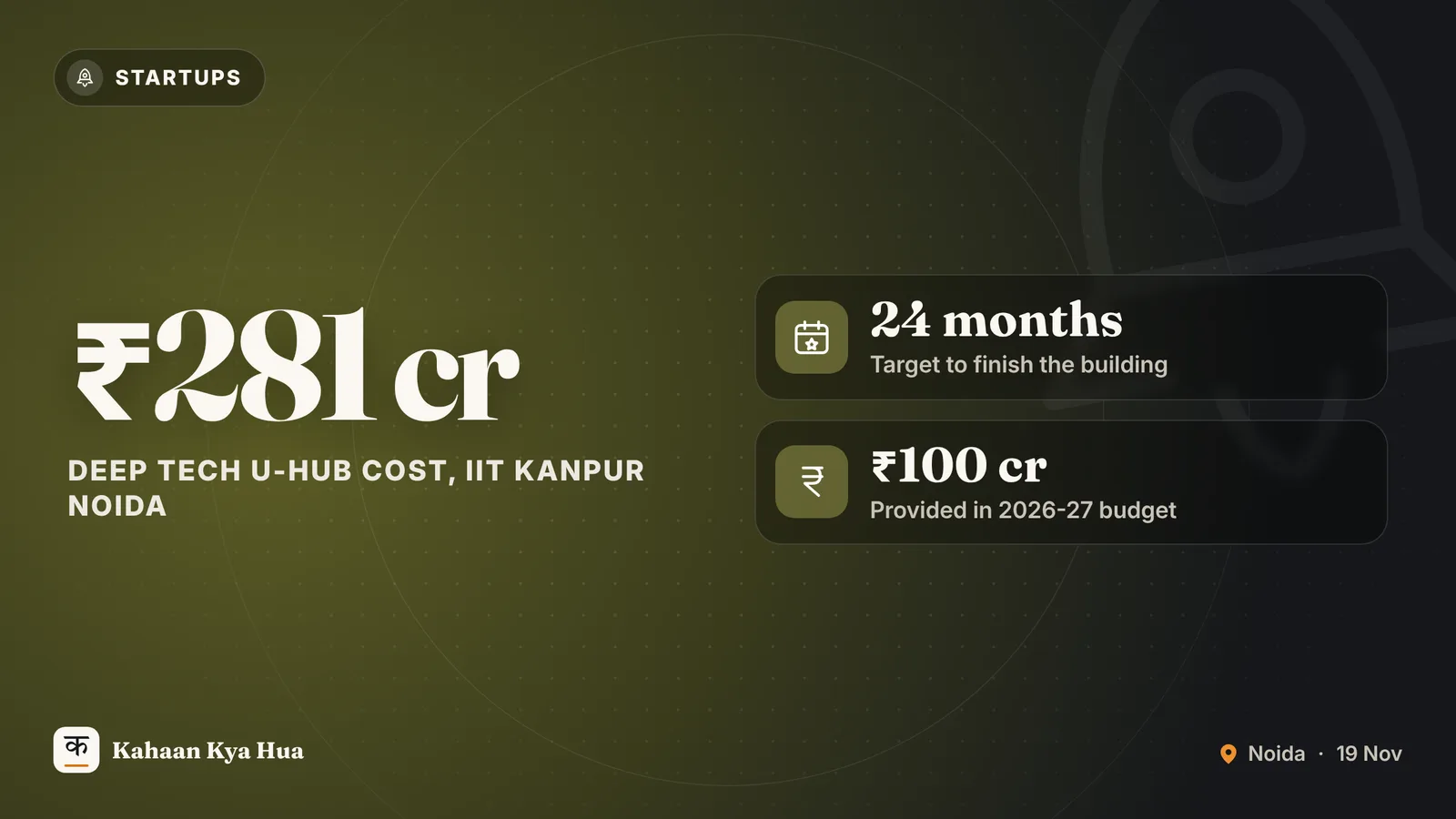
The Uttar Pradesh cabinet has approved a Deep Tech U-Hub to be built at the Noida campus of IIT Kanpur at a cost of about ₹281 crore. The decision came at a cabinet meeting chaired by Chief Minister Yogi Adityanath on Wednesday, 18 November 2026, where 30 of 31 proposals placed before the cabinet were cleared, according to a state government statement.
What has been approved
The cabinet cleared the setting up of the Deep Tech U-Hub and the construction of its building on the IIT Kanpur campus in Noida. Finance and Parliamentary Affairs Minister Suresh Kumar Khanna said the Expenditure Finance Committee has pegged the total cost at ₹28,103.88 lakh, which works out to ₹281.03 crore. The building will be built in the EPC (engineering, procurement and construction) mode, and the target is to finish it within 24 months.
One report gave the figure as an initial allocation of ₹28.10 lakh. That does not match the minister's figure as reported by two other outlets, and appears to leave out the thousands in ₹28,103.88 lakh, so this report uses ₹281.03 crore.
How the money is arranged
A budgetary provision of ₹100 crore has been made for 2026-27. Of this, ₹30 crore is under the capital head and ₹70 crore under the revenue head. The remaining requirement will be approved in phases after consultation with the Finance Department. The Centre will not share the cost, so the whole project is a state expense.
What the U-Hub is meant to do
The hub will be set up as a registered entity under Section 8 of the Companies Act, meaning a not-for-profit company. Its stated purpose is to encourage innovation-driven research and technology-led entrepreneurship in the state. According to the government statement, it will offer startups in Uttar Pradesh mentorship, technical help and guidance, with the aim of raising both the number and the quality of successful startups. The government also expects new technology-based companies and skilled jobs for young people.
The hub is to sit on the Noida campus of IIT Kanpur, the Kanpur-based institute. The sources do not say how many startups the hub will support, how many people it will employ, or when the first batch will be admitted, so those details remain to be announced.
Other cabinet decisions the same day
The cabinet also took several decisions that touch daily life:
- ASHA workers: the state-funded monthly incentive under the National Health Mission goes up by ₹1,000. ASHA workers who now get ₹2,000 for NHM work plus ₹1,500 from the state budget will get ₹4,500 a month. Those receiving ₹9,650 for various Centre and state activities will also get ₹1,000 more.
- Regional airports: the state will sign a tripartite agreement with the Centre and the Airports Authority of India for the next phase of the regional connectivity scheme, Modified UDAN. VAT on aviation fuel at such airports will be 1 per cent or less, with free fire and security services and concessional power and water. The state will bear 20 per cent of the viability gap funding.
- Cooperative college in Lucknow: 4.51 hectares of land of the State Institute of Agricultural Management at Rahman Khera will be transferred for a state cooperative college offering courses in artificial intelligence, cybercrime and banking for cooperative sector professionals, affiliated with Tribhuvan Sahakari University, Gujarat.
- Bio-energy policy: bio-energy plants can now be set up according to the availability of bio-waste, instead of being limited to one plant per tehsil.
- Women and child safety: compensation for women and children who are victims of sexual offences and other serious crimes under the Rani Lakshmibai Women and Child Honour Fund Rules, 2026, will be in line with the 2018 NALSA compensation scheme.
- Sports: 2.476 hectares in Agra district will be given free to the sports department for a stadium.
- Tourism policy: incentives are being extended to smaller hotels with six rooms and to farm stays.
Why it matters for Kanpur and the state
For IIT Kanpur, the approval gives the institute's Noida campus a large state-funded building to host startup and research activity. For founders in Uttar Pradesh, the promise is mentorship and technical support closer to the Delhi region, although the exact services and eligibility will depend on how the Section 8 company is structured.
What to watch next
The first things to look for are the tender for the EPC contractor, the formation of the Section 8 company and its board, and the phased release of funds beyond the ₹100 crore for this financial year. Startups interested in the hub should watch IIT Kanpur's and the state government's official announcements for application details, since none have been published yet.