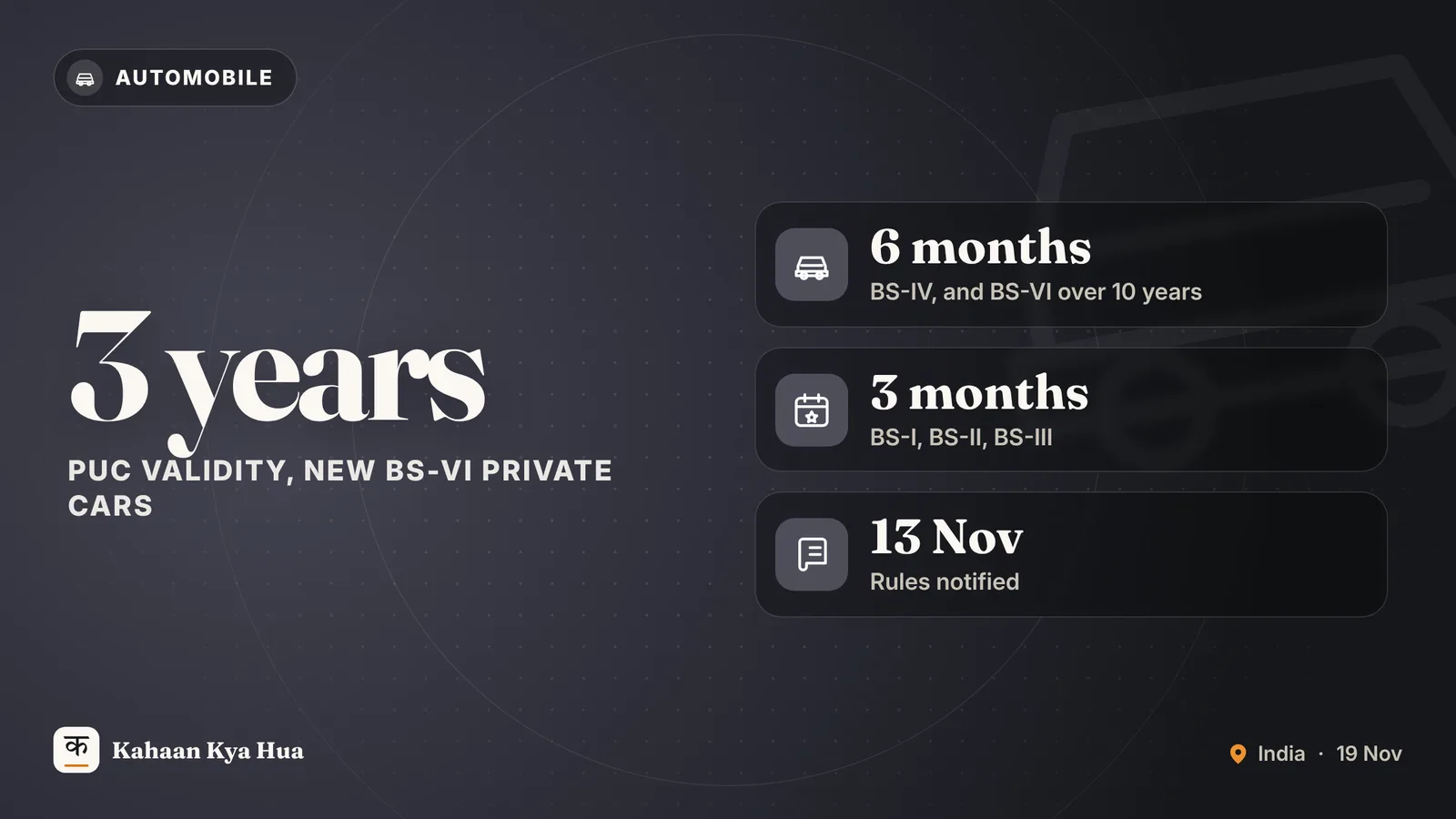
The Centre has changed how long a Pollution Under Control (PUC) certificate stays valid, and the new schedule depends on the age of the vehicle, not just its Bharat Stage (BS) emission category. Owners of newer private BS-VI cars will need to test their vehicles only once every three years. Owners of older vehicles will have to test more often. The rules were notified by the road transport ministry on 13 November and were reported widely on 19 November.
What has changed
According to The Times of India, Hindustan Times and The Hindu, the changes come through the Central Motor Vehicles (Sixteenth Amendment) Rules, 2026, which amend Rule 115(7) of the Central Motor Vehicles Rules, 1989. They came into force when they were published in the Official Gazette. Earlier, a BS-VI private car and an older BS-VI commercial vehicle both got a certificate valid for 12 months. That is no longer the case. Age is counted from the date of first registration.
New validity, category by category
For BS-VI private vehicles:
- Up to six years old: valid for three years (earlier 12 months).
- More than six and up to 10 years: 12 months, unchanged.
- More than 10 years: six months (earlier 12 months).
For BS-VI commercial or transport vehicles:
- Up to six years old: two years (earlier 12 months).
- More than six and up to 10 years: 12 months.
- More than 10 years: six months.
For older emission standards, the validity is the same whatever the age or use:
- BS-I, BS-II and BS-III vehicles: three months.
- BS-IV vehicles: six months, private or commercial.
The Times of India notes that some states had already set shorter periods. Delhi, for instance, already asked BS-I to BS-III vehicles to test every three months, and parts of the NCR had a six-month period for BS-IV. The new rule makes these intervals the same across all states and Union territories.
What happens to the certificate you already hold
If you hold a PUC certificate issued before the amendment, it stays valid until its own expiry date. Nothing needs to be redone now. The new schedule applies only when you renew for the first time under the amended rules. The Times of India gives an example: a private BS-VI car that is four years old and holds a one-year certificate will become eligible for a three-year certificate at its next renewal, but the current certificate will not be extended automatically.
When does the new certificate start
The rules also settle a small but common question. If you get the test done within the 10 days before your certificate expires, the new certificate will start from the old expiry date, so you lose no days by testing early. If you test after the certificate has expired, the new one starts from the date of the test.
Why it matters for drivers
A PUC certificate is a mandatory document, and a vehicle without a valid one can be challenged at a check or fined under traffic rules. For the owner of a new car, this means fewer trips to the testing centre and less paperwork. For owners of older petrol and diesel vehicles, it means regular tests, with BS-I to BS-III vehicles needing one four times a year.
The amendment also makes a clear policy choice: vehicles that came out under newer, cleaner norms are treated as lower risk in their early years, while ageing vehicles, whose engines and exhaust systems are more likely to wear, are tested more often. The government's notification did not announce new penalties or fees, and the reports we reviewed did not mention changes to testing charges.
What to do now
Check the BS category and registration date on your registration certificate. Note when your current PUC expires and plan to test within the 10-day window if you want the new validity to carry on without a gap. If you drive an older car, put the three-month or six-month deadline in your phone calendar, since a lapsed certificate is easy to miss. Fleet and taxi operators with older vehicles will want to revise their compliance schedules.
What next
States are expected to follow the central schedule through their transport departments and testing centres. Readers should watch for any state notices or changes to the Vahan and PUC portals, which will show how the new validity period is printed on certificates. For authoritative details, the notification itself is in the Official Gazette of the road transport ministry.