

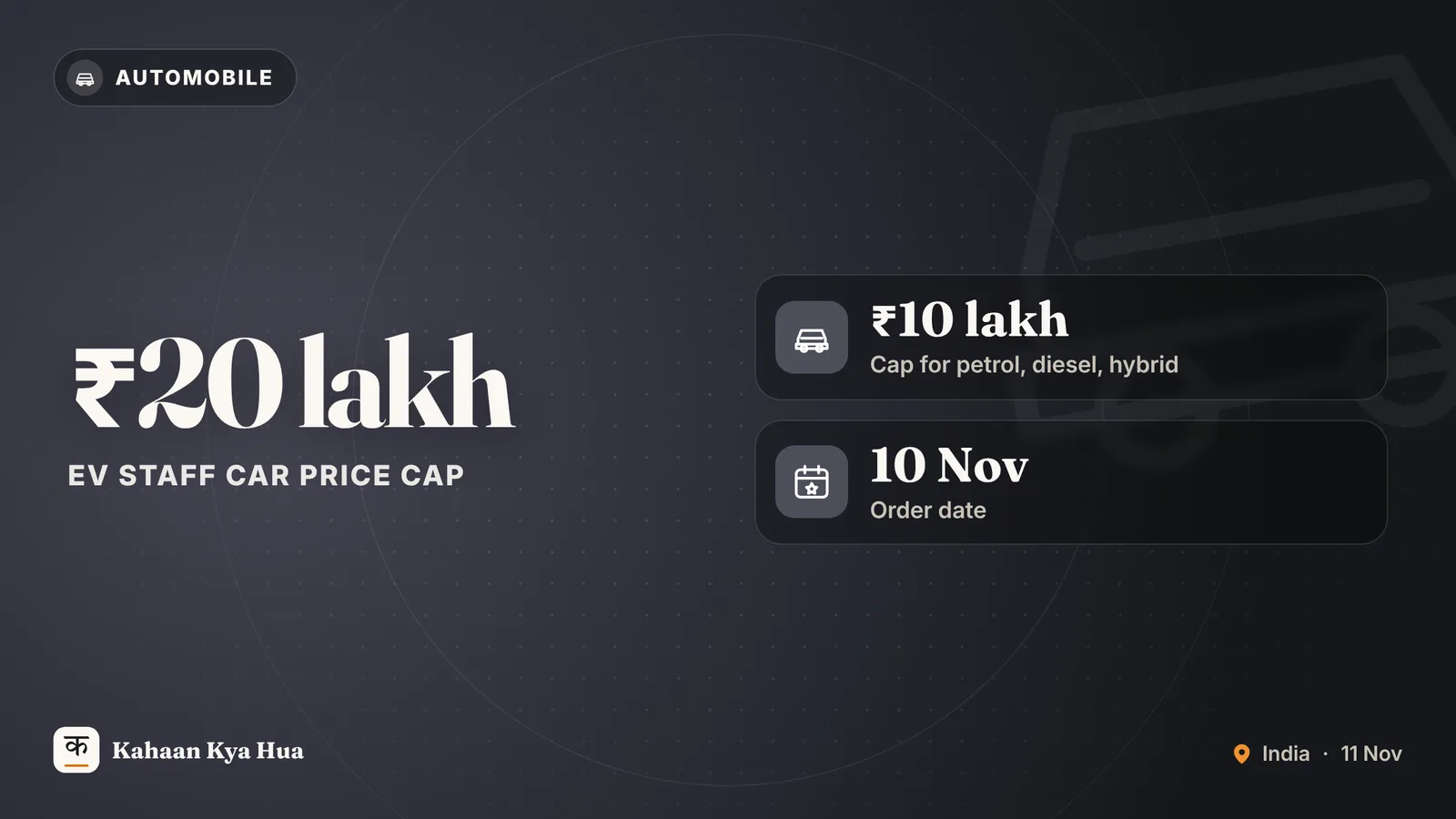
The Finance Ministry has told central ministries and departments to make electric vehicles their "default and preferred choice" when they buy staff cars. At the same time it has set a new price ceiling of Rs 20 lakh for electric staff cars, according to Hindustan Times and The Financial Express.
What the order says
The instructions come in an office memorandum from the Department of Expenditure dated 10 November. The ceiling is expressed as Net Dealer Price. For electric vehicles it is now Rs 20 lakh. For petrol, diesel and hybrid vehicles it is Rs 10 lakh, so the limit for an EV is double that for a conventional car. Both reports say the earlier 2022 guidelines had fixed a Net Dealer Price ceiling of Rs 6 lakh for staff cars.
The ministry explains that the revision is meant to promote electric mobility, cut dependence on fossil fuels, and reflect current market prices and the cost of owning a vehicle over its life. The Financial Express says the new rules apply with immediate effect.
When it applies
The rule covers purchases made when a department condemns, or retires, an old petrol or diesel staff car and needs a replacement. In those cases ministries and departments are expected to buy an EV in the ordinary course.
A department that feels an EV is not practical can still buy a conventional car, but it must send a justified proposal to the Department of Expenditure, which will decide on relaxation case by case. Hindustan Times reports that such a proposal needs the approval of the Secretary of the ministry and the concurrence of its Financial Adviser. The same process applies if a department wants to hire, rather than buy, a conventional car.
Hiring is also covered. The ministry says the instructions of 1 September 2022, which require departments to hire EVs, remain in force. Everything else about entitlement, procurement and hiring is unchanged, and purchases continue under the General Financial Rules, 2017.
What industry experts say
The Financial Express quotes two industry analysts. Hemal N Thakkar of Crisil Intelligence calls it a very good move, arguing that when policy makers use electric cars themselves it can influence the public. He says government purchases are roughly 2 to 5 per cent of overall car sales and that vehicles are typically held for four to six years.
Ravi Bhatia of JATO Dynamics says the order shifts the approach from incentives to institutional buying preference, and that a higher ceiling widens the range of eligible EVs. He cautions that the effect on sales will be gradual and will depend on how many vehicles departments actually buy, replacement cycles and budgets. Charging infrastructure, service support and total cost of ownership will matter too, he adds.
Why it matters
Staff cars are a small slice of the market, but the order is a clear signal. A Rs 20 lakh ceiling covers a good range of electric cars on sale in India, which was not possible under the old Rs 6 lakh limit. If state governments and public sector companies follow, as Mr Bhatia suggests, the demand for EVs could become steadier.
For ordinary buyers nothing changes directly. The order does not alter taxes, subsidies or prices of cars sold to the public. It only sets how central government offices spend their own vehicle budgets.