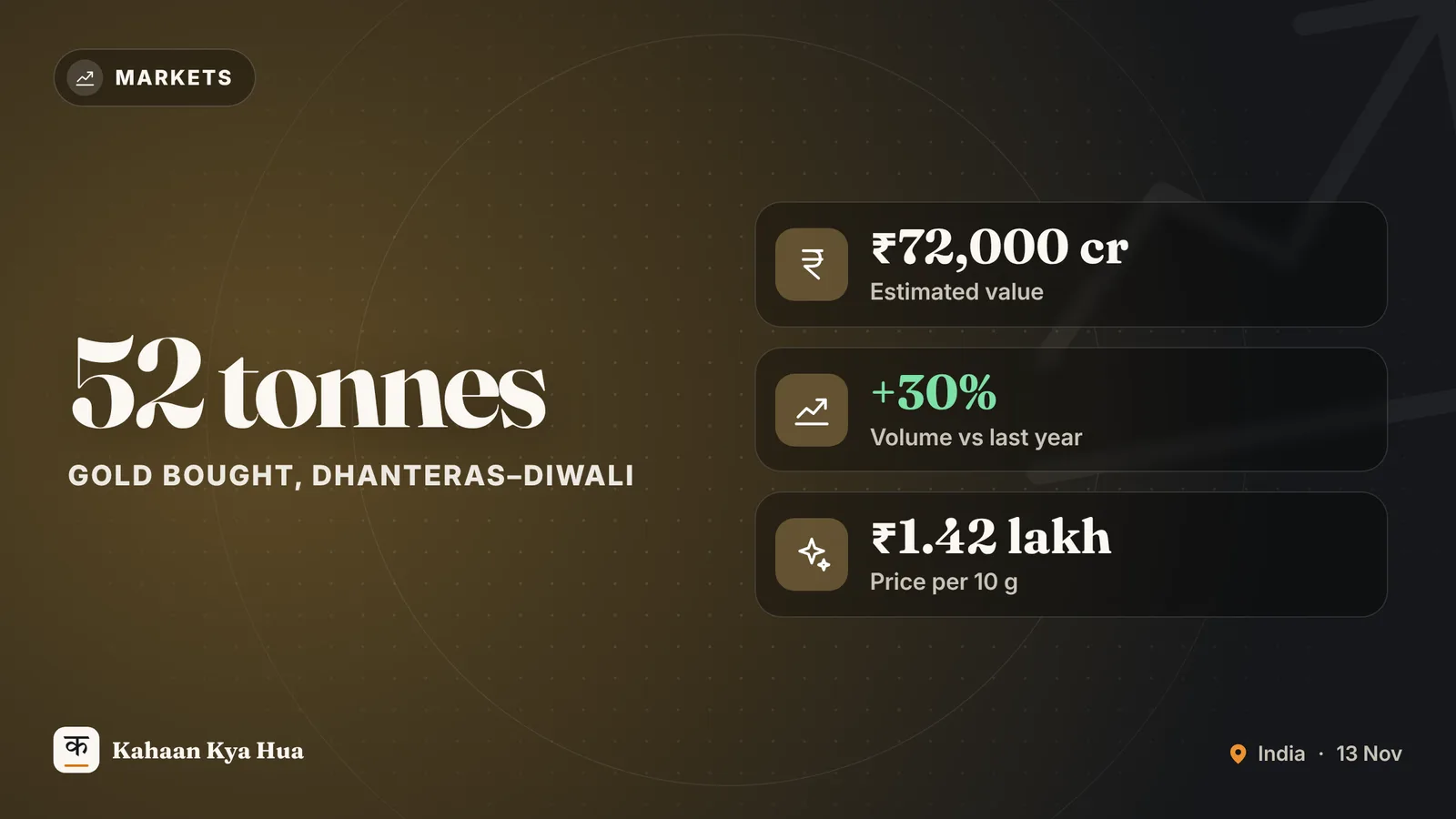
Indians bought far more gold and silver during this year's Dhanteras and Diwali than a year ago, even though prices were well below their peak. The India Bullion and Jewellers Association (IBJA) estimates that buyers took home about 52 tonnes of gold worth ₹72,000 crore, along with 300 tonnes of silver worth about ₹5,400 crore, over the festival days.
What the numbers say
According to IBJA, gold demand rose 30% in volume terms compared with the same festival period last year, while silver buying grew 10%. Dhanteras fell on 6 November and Diwali on 8 November. These are industry-body estimates, not audited sales data, and they were reported by The Times of India and Bhaskar English.
The rise follows a sharp correction. Gold had touched a record of around ₹1.8 lakh per 10 grams and slipped to about ₹1.42 lakh around the festival, a fall of roughly ₹38,000 or 21%. For comparison, the metal was near ₹60,000 in 2023 and ₹80,000 in 2024, so even after the fall it is far above where it stood two years ago.
Why buyers came back
Reports quote industry officials giving several reasons. Many families had postponed purchases while prices climbed. Through September of this financial year, gold sales by volume were down by nearly 50%, which the reports link to high prices, a higher import duty and Prime Minister Narendra Modi's appeal to people to hold off buying gold. The lower price brought some of that held-back demand into the festival.
Timing helped too. Both festival days came early in the month, when salaried workers usually have their pay and bonuses in hand. The wedding season, which runs from mid-November to March, also pulled purchases forward. IBJA national secretary Surendra Mehta said buying was continuing after the festival.
Jewellers also reported strong demand in diamonds. A Bengaluru jeweller, C Krishniah Chetty Jewellers, said its natural diamond sales on Dhanteras were 250% higher than last year, and that lab-grown diamonds are a growing but separate category. That figure comes from one retailer and should not be read as an industry-wide number.
Prices are still falling
The festival rush has not stopped the slide. On Thursday, 12 November, December gold futures on the Multi Commodity Exchange traded near ₹1.38 lakh per 10 grams, down about 0.9%, and December silver futures fell 1.3% to about ₹1.82 lakh per kg, according to CNBC TV18.
Globally, gold slipped below the $4,000-per-ounce mark. The report links the move to US consumer inflation of 0.4% in October, against expectations of 0.3%, which raised fears that the US Federal Reserve will keep interest rates high or raise them again. Higher US interest rates and a stronger dollar tend to weigh on gold, which pays no interest. Prithviraj Kothari of the bullion association said gold could test $3,900 an ounce if the weakness continues, while buying by central banks, including China's, is limiting the fall.
What it means for buyers
For a family planning a wedding purchase, the picture is mixed. Prices have come down from the peak, and analysts quoted in the reports see further near-term pressure from US rates. But nobody in these reports claims to know where prices go next. Mehta pointed to a possible rebound if crude oil keeps cooling, while the global factors above point the other way.
Anyone buying should check the day's rate for the exact purity, ask for a bill that lists hallmark and making charges separately, and compare quotes from more than one jeweller. Rates differ by city and change through the day.
What to watch next
Over the next few weeks, the signals to watch are the next US inflation and interest-rate decisions, crude oil prices, and whether wedding-season buying holds up if gold keeps slipping. IBJA's wedding-season commentary will be the next sign of whether the festival surge was a one-off or the start of a recovery.