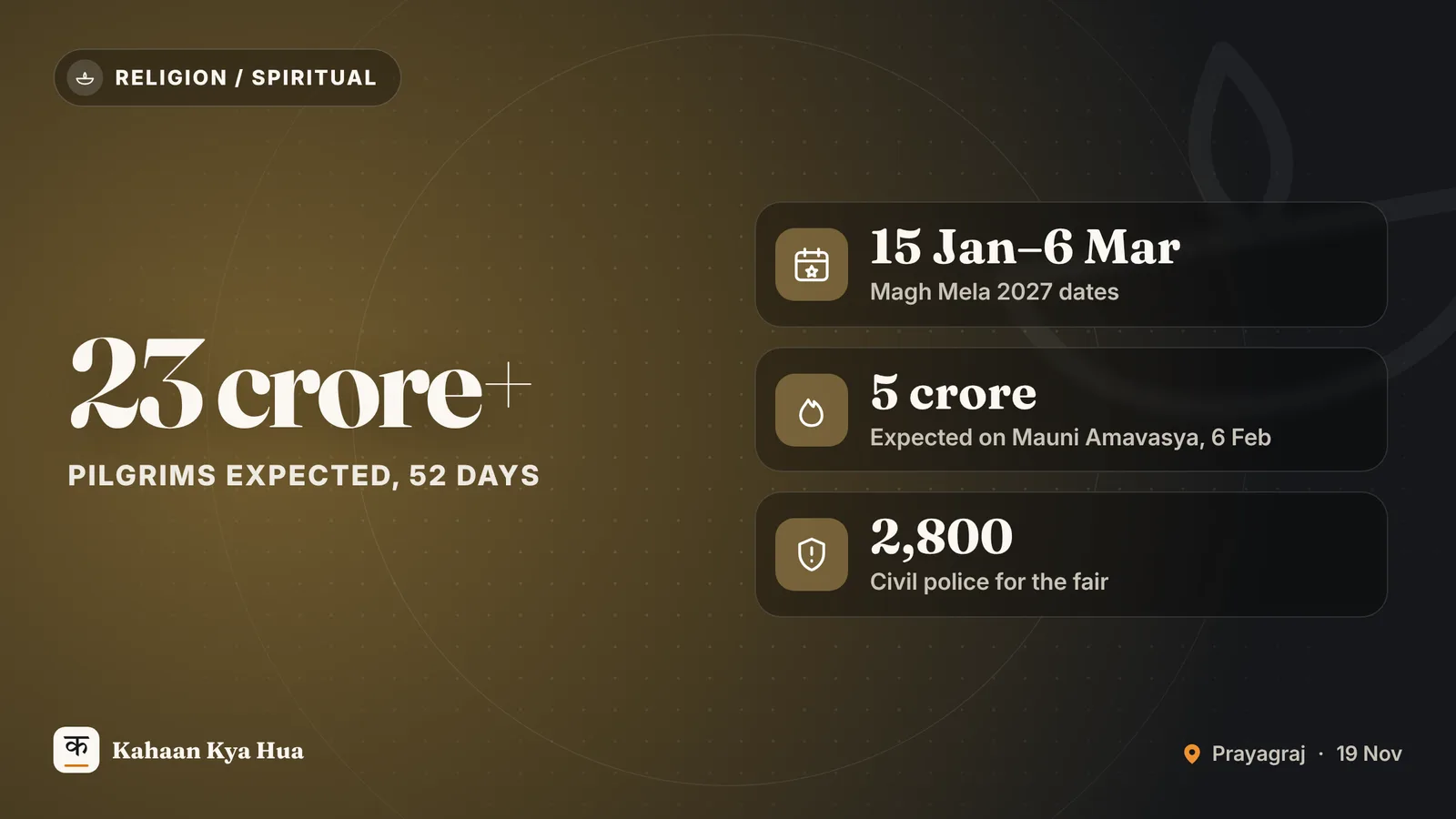
The Magh Mela at Prayagraj will begin on 15 January 2027 and run for 52 days until 6 March, and the fair administration expects more than 23 crore people to bathe at the Sangam over that period. The projection, reported by Amar Ujala on Thursday after early planning meetings, would beat the record set earlier this year, when over 22.10 crore pilgrims took a dip during a 44-day fair.
What the administration expects
The mela authority has put numbers on each of the six main bathing days. Mauni Amavasya is expected to be the biggest, with about 5 crore people reaching the Sangam. Basant Panchami is projected at around 4 crore, Maghi Purnima at 2.25 crore, Makar Sankranti at 1.13 crore, Mahashivratri at 42 lakh and Paush Purnima at 40 lakh. Added together, the six dates account for roughly 13 crore visitors, so the remaining crowd is expected to come on ordinary days across the 52-day stretch.
According to a schedule carried by ETV Bharat, the key dates are Makar Sankranti on 15 January, Paush Purnima on 22 January, Mauni Amavasya on 6 February, Basant Panchami on 11 February, Maghi Purnima on 20 February and Mahashivratri on 6 March. Indian Railways has separately told reporters it is planning for more than 20 crore passengers and special mela trains, an estimate that is lower than the fair administration's own figure. Both numbers are forecasts, not counts.
A bigger mela area
The fair will be set up in eight sectors across about 925 hectares, spread along roughly 3.75 km of riverbank. More than 25 ghats will be built. NavBharat Live, reporting on the first coordination meeting in August, said the area is about 81 hectares larger than in 2026, with two additional pontoon bridges planned on top of the nine used last year. Parking is to grow from 250 to 280 hectares, and the number of CCTV cameras from 400 to 1,152, according to the same report. Those figures come from the August planning meeting and may have been revised since.
The administration is also preparing a floating jetty for Ganga puja in the first week of December, controlled diversion of the river's flow and temporary embankments. Water sports and floating restaurants are among the facilities being considered for pilgrims. Land levelling has started and ground-breaking rituals have begun, officials said.
Water from Narora, through Kanpur
To keep the Sangam supplied, about 10,000 cusecs of water is to be released from Narora Barrage and carried down through the Kanpur Barrage to Prayagraj, Amar Ujala reported. For readers in Kanpur, that means the barrage's gates will play a part in the fair's arrangements, and flow management upstream will be watched closely through January and February.
Security and help desks
For security, the mela will have about 2,800 civil police, 250 women police and 500 traffic police. Mounted police, LIU, Home Guards, radio operators, water police, divers and trainee constables will also be deployed. The administration plans 16 cyber help centres and 16 women's help centres inside the fair.
A new rule will also come into force: the Uttar Pradesh Inland Vessels Rules 2026 will apply for the first time at the mela. Motorised boats will be registered with the ARTO administration, while non-motorised boats will be registered by officers nominated at district and tehsil level. The change is meant to bring the large boatman community under one regulated system during the fair.
What happens next
A review meeting chaired by the divisional commissioner was scheduled for Thursday, according to SDM Mela Abhinav Pathak, who spoke to Amar Ujala. Pilgrims planning to travel in January and February should expect railway and road advisories closer to the dates, and the fair authority is likely to publish sector maps and parking plans once layouts are fixed. We will update this report when the administration releases the final schedule and traffic plan.
Why it matters
The Magh Mela is the largest annual religious gathering in Uttar Pradesh, and each edition has grown in scale. The 2027 plan shows how quickly the state is expanding infrastructure for such crowds, from water release to boat regulation. For traders, boatmen, transporters and hotels in Prayagraj and nearby cities such as Kanpur and Varanasi, the forecast also signals a heavy season of footfall.