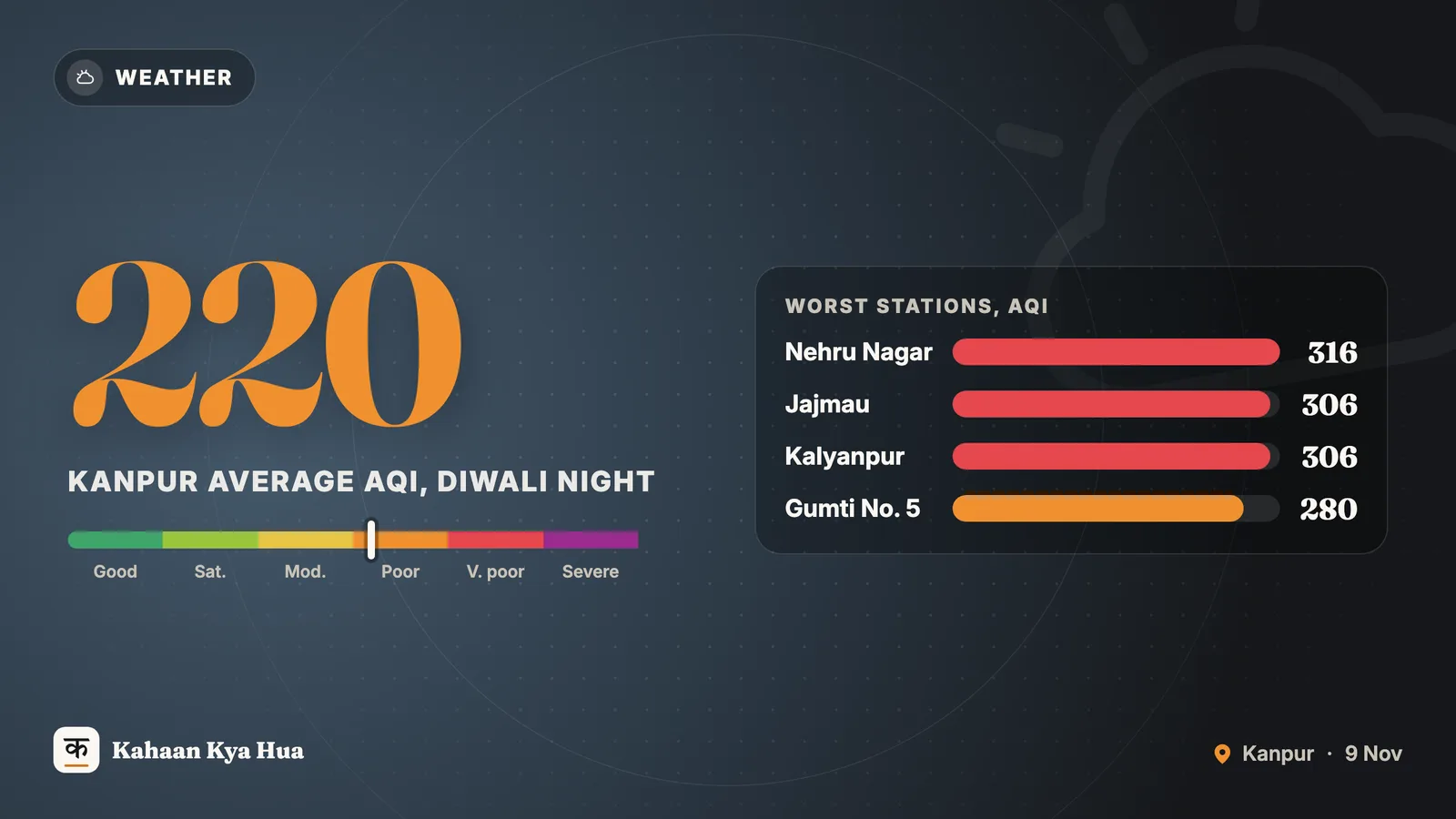
Kanpur's air turned poor to very poor after Diwali night, with the city's average Air Quality Index (AQI) touching 220 on Sunday evening and several real-time stations crossing 300 by Monday, according to figures reported by local and national outlets on 9 November 2026.
What the numbers show
Amar Ujala, citing a Central Pollution Control Board (CPCB) report, said the city average read 220 late on Diwali evening and kept rising as fireworks continued. The same report put Kanpur at just 47 on 1 November, 108 on 2 November and 203 on 3 November, so the air had already been worsening before the festival.
ETV Bharat, quoting real-time station data, listed Nehru Nagar at 316, Jajmau at 306 and Kalyanpur at 306, all in the "very poor" band (301 to 400). Gumti No. 5 read 280 and Ahirwan 267. Barra-2 and Dabauli read 243 each, Govind Nagar 230, IIT Kanpur 193 and FTI Kidwai Nagar 154. A separate Uttar Pradesh Pollution Control Board list in the same report gave Kidwai Nagar 223, Nehru Nagar 238 and NSI Kalyanpur 245. ETV says the two lists come from different times or monitoring sources and should not be read as one set. The report also gave PM2.5 at 106 and PM10 at 189 micrograms per cubic metre at the cited station.
Why the numbers look so different
Dainik Bhaskar reported that on AQI.in, a private platform, Kanpur's reading touched 1,483 around 11.30 pm to midnight, putting it among the five most polluted cities in the country for a short while, and 1,344 at 12.30 am. That figure is not comparable with the CPCB's 220. The official index is a 24-hour or station-average measure capped at 500, while private platforms often show short-term spikes on a different scale. In short: official readings tell you the day's burden, hourly spikes tell you how bad the worst hours were. Both agree the air was bad.
Weather on Monday
Bhaskar quoted the Chaudhary Sarwan Kumar Agricultural University (CSA) weather report: Sunday's maximum was 30 degrees Celsius and the minimum 14.6 degrees, each about 0.1 degree above normal. Monday began cold with haze and low visibility, with the day expected to warm to around 30 degrees under sun. Weather expert Dr S N Sunil Pandey told ETV Bharat that smoke from Diwali night lingered into the morning and that fog added to the problem.
What to do today
- Dr Pandey advised wearing an N95 mask when stepping out on Monday, especially in the morning haze.
- Bhaskar, citing experts, advised skipping morning walks and open-air exercise until pollution eases.
- People reported breathlessness, throat irritation, cough and burning eyes after the night of fireworks, according to Bhaskar. Children, older people and those with asthma or heart conditions should limit time outdoors.
- Keep windows closed during the early morning and late night hours, when smoke settles close to the ground.
Regional picture
Business Today reported that Lucknow, Kanpur and Jaipur also recorded elevated levels on Monday while Noida (341), Ghaziabad (357), Gurugram (328) and Faridabad (342) were "very poor" on CPCB figures. Stagnant weather was keeping pollutants near the ground. Delhi's own numbers are under a separate dispute over data gaps, which we explain in a companion report.
What next
Pollution usually eases only when winds pick up or it rains. None of the reports cited here gives an official forecast for Kanpur's air this week, so readers should check CPCB's live Kanpur stations through the day. Kanpur's festival calendar continues with Govardhan Puja on Tuesday and Bhai Dooj on Wednesday, so crowds and traffic smoke will not disappear soon.